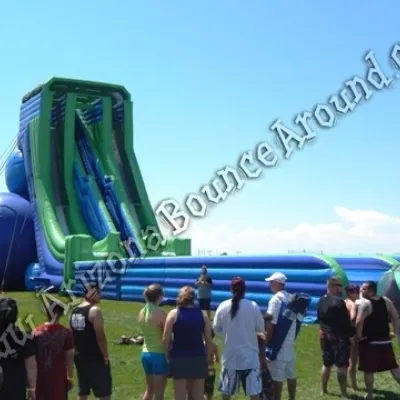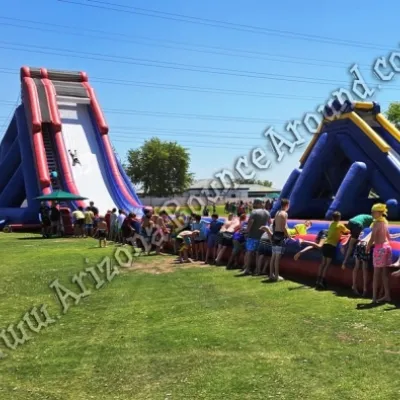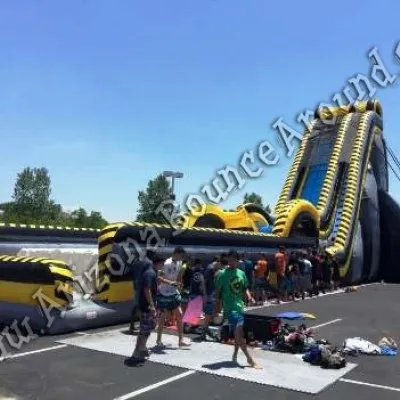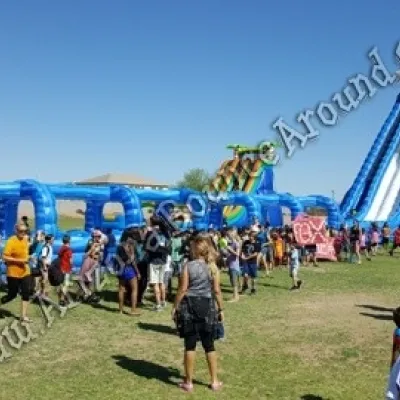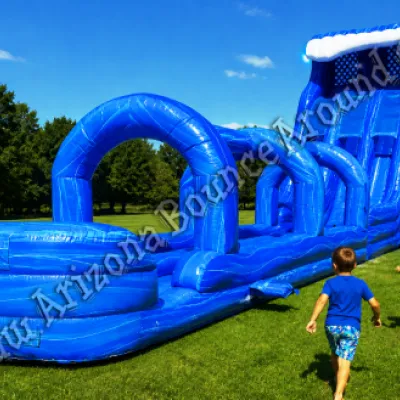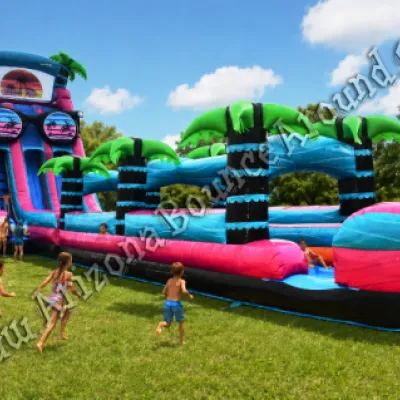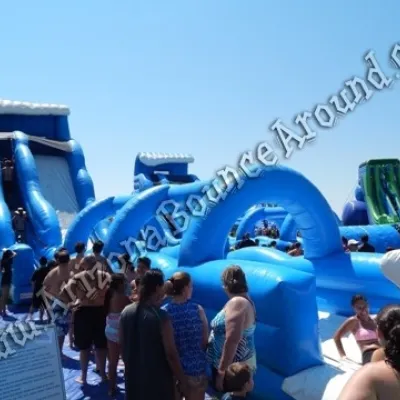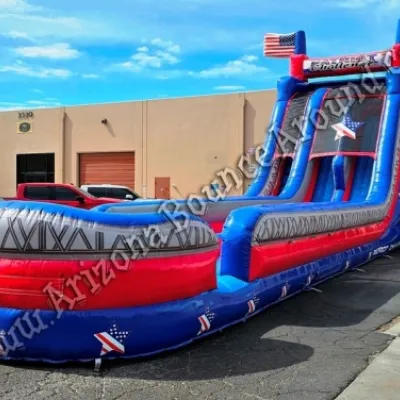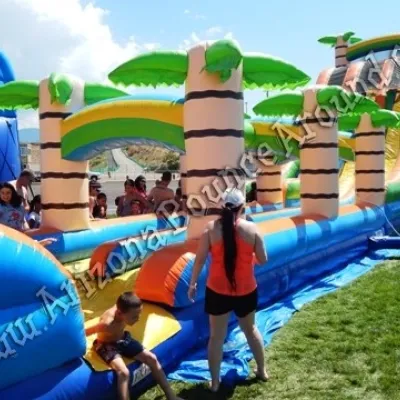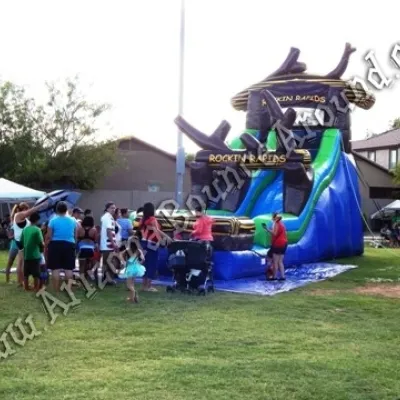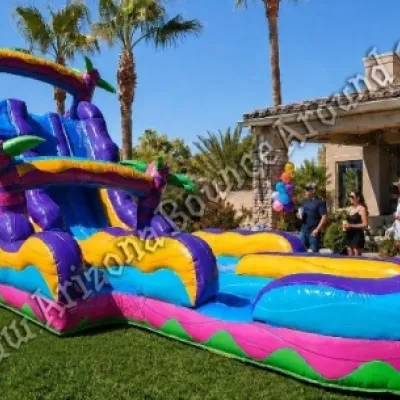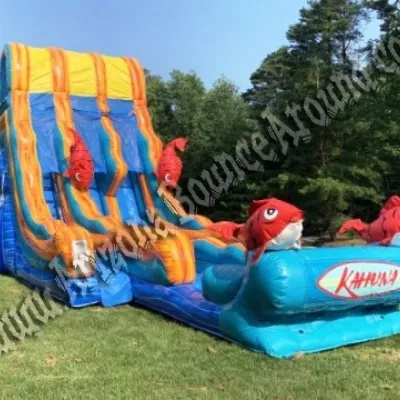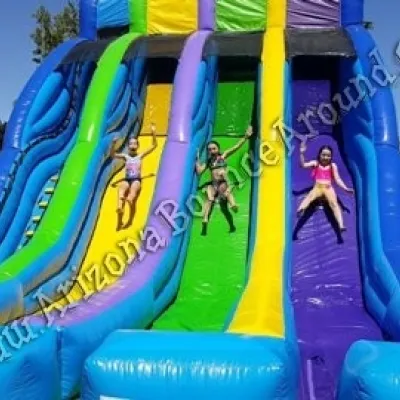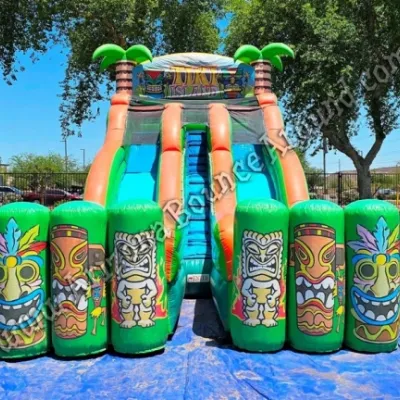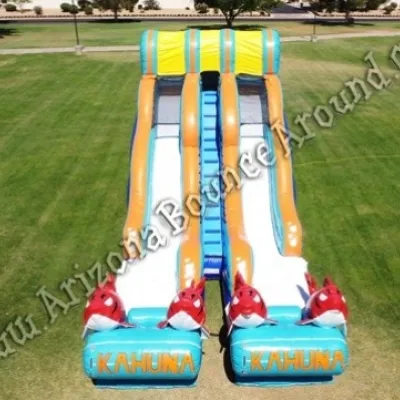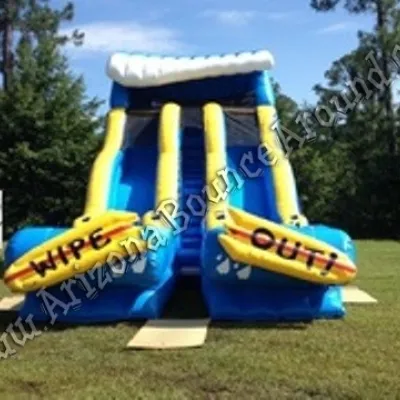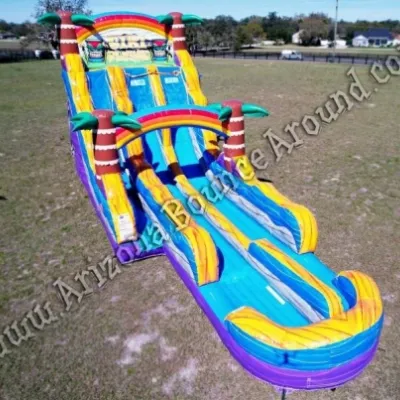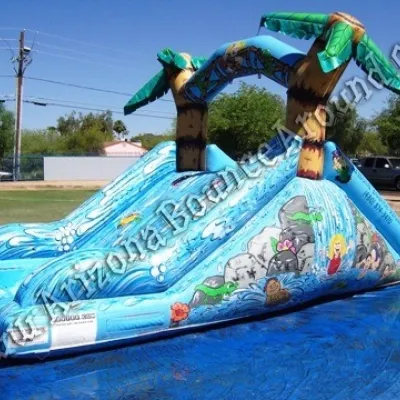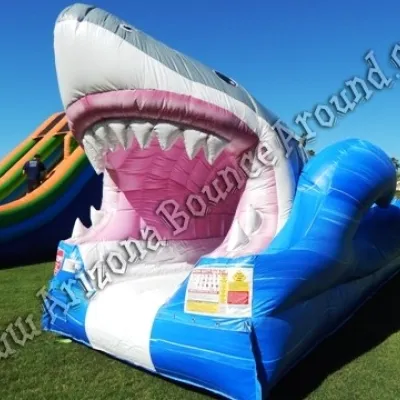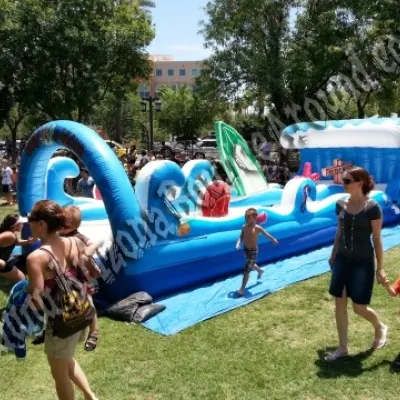
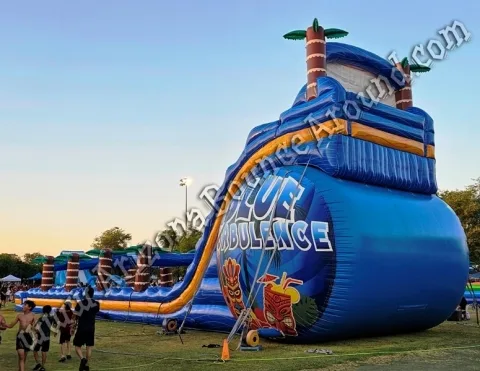
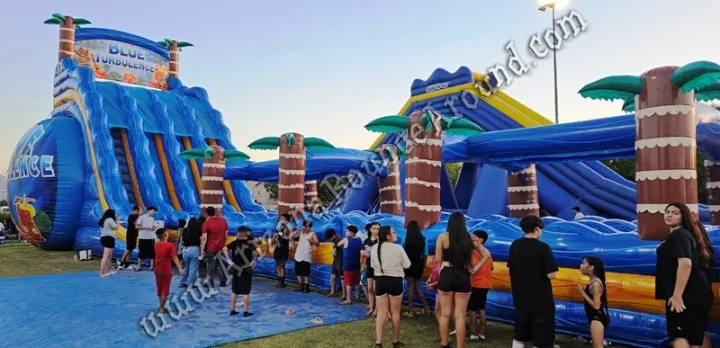
Rent a 3 Lane Blue Turbulence Water Slide in Phoenix - 33' tall and 100' long
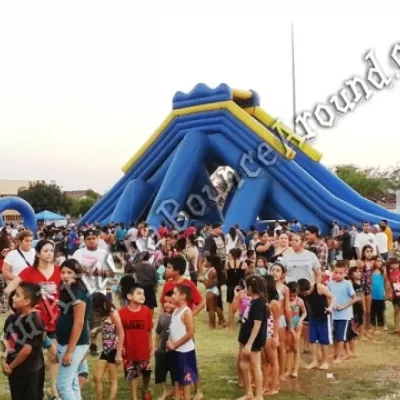
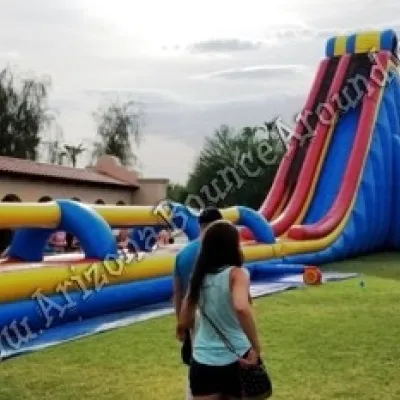
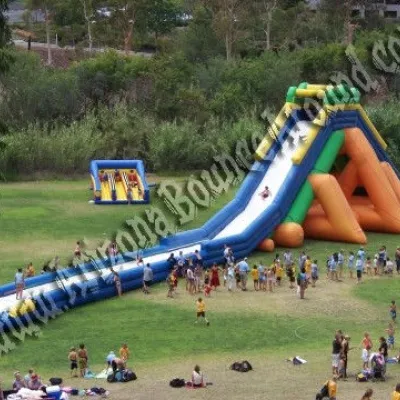
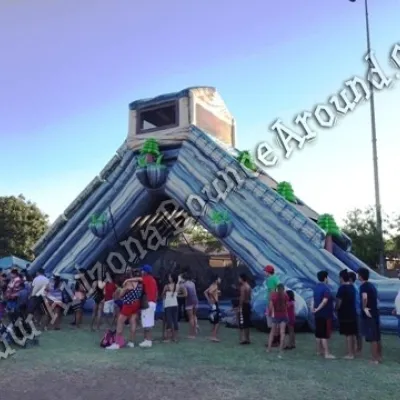
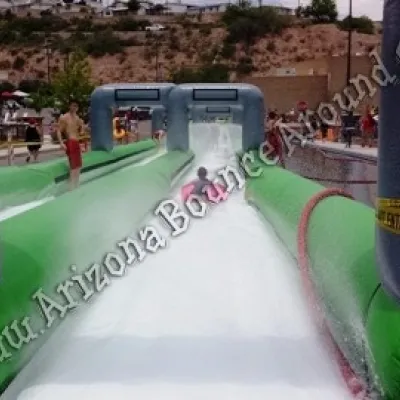
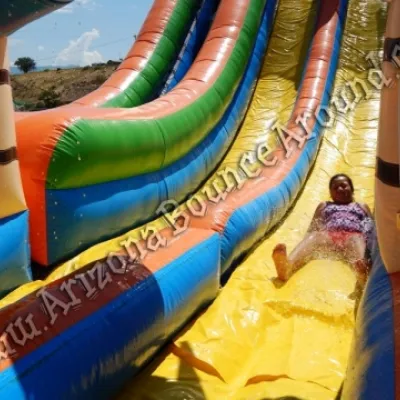
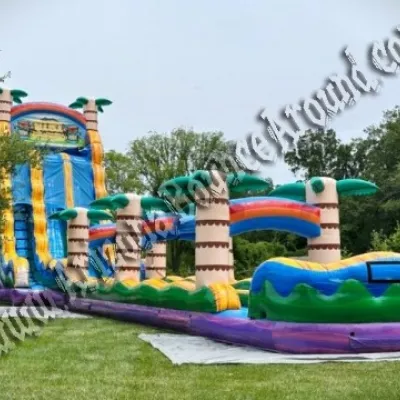
Our Giant Three-Lane water slide is sure to please at any summer party or event in Arizona. Perfect for kids and adults looking for a giant water slide
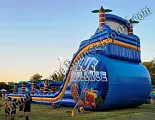
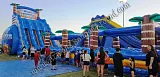
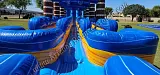
| Wide: | 30' (9.14 m) |
| Tall: | 35' (10.66 m) |
| Long: | 140' (42.67 m) |
Rent a 3 lane Blue Turbulence water slide by calling 480-874-3470
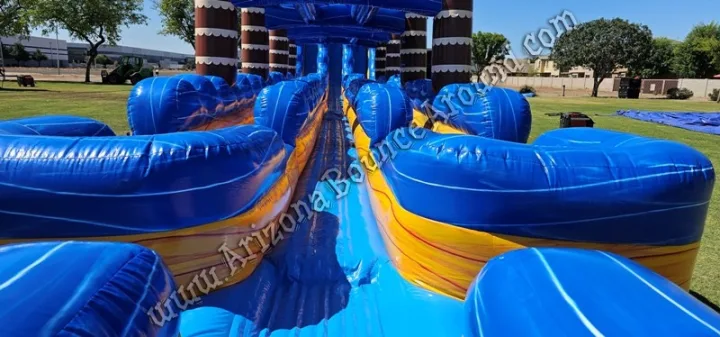
Our three-lane, 33-foot-tall water slide is perfect to draw attention to your event, standing 33 feet tall and 100 feet long. This slide features three slide lanes and easy-to-climb steps, perfect for almost all age groups but sure to thrill everyone at the party.
Please call one of our special event planners today to start planning your summer event now before all the big water slides are rented for your event date. We've offered full staffing, event management, and event security all under one roof since 2002.
33' Blue Turbulence
Triple-Lane Water Slide
Phoenix Rental Guide
Overview and Key Features: 33' Tall Blue Turbulence Triple Lane Water Slide Rental Phoenix
Key information / summary: The 33' Blue Turbulence is a premium, visually striking triple-lane water slide engineered for high-throughput summer events in Phoenix. Customers search both generic and very specific phrases (e.g., “33' water slide rental Phoenix”, “triple lane water slide near me”, “blue turbulence slide 33 foot”).
- Primary pros:
- High visual appeal: the iconic blue “turbulence” design attracts families and encourages social sharing.
- Triple lanes increase throughput, good for parties, schools, and festivals.
- 33' height provides a wow factor that justifies premium pricing.
- Durable commercial-grade materials suited to repeated Phoenix summer use.
- Primary cons:
- Requires a larger delivery/truck footprint and more setup time—resulting in higher operational costs.
- Safety and staffing expectations rise with height and lane count (staff recommended).
- Main points discussed:
- Operational considerations: delivery, setup, staffing, insurance, and permits in Phoenix.
- Pricing strategies and bundling (add-ons, multi-item discounts, peak-season surcharges).
- User sentiment analysis from forums and review platforms: what renters care about most.
Comprehensive Outline
- Product Snapshot: Specs, safety, and on-site requirements
- Audience-targeted strategies
- Real-world examples & A/B test case studies
- Customer voice & social proof: Reddit, Trustpilot, Facebook groups
- Pricing and bundling tactics for Phoenix seasonality
- Operational checklist: transport, setup, staffing, safety equipment, permits
User Reviews & Social Proof
Social and review platforms show consistent themes: thrill and visual appeal drive bookings; setup reliability and clear policies drive repeat customers.
- Reddit (local threads & event planning):
- Quote: "u/phoenixplanner: 'Booked a 33' triple-lane last summer for a neighborhood block party. Kids loved racing. The delivery crew was on time but required a 90-minute setup, worth it for the photos, though!
- Quote: "u/momof3AZ: 'If you're renting in Phoenix, ask about sun-mat placement and extra shade. The slide is awesome, but the heat is real—we added canopy time."
- Facebook & Local Nextdoor posts:
- Quote: "Local Party Group: 'Triple lanes make flow so much better than a single slide—no long lines = happier kids and parents. Ask for staff if you have over 30 kids."
- Trustpilot / Google Reviews (rental business listings):
- Typical positive: "Great communication and on-time setup. Slide was clean and exactly as pictured 5 stars."
- Typical negative: "Reservation confusion and a last-minute 20% extra charge for restricted setup time. Loved the slide, but watch the contract."
Compare Viewpoints: Customers vs. Experts vs. Operators
- Customers emphasize experience (fun factor, wait times, safety). They reward transparency in pricing and punctuality.
- Event industry experts/consultants recommend clear operational SOPs (staffing ratios, safety briefings, and liability waivers) for tall slides and advise premium pricing for the 33' class because of perceived risk/reward.
- Local operators focus on logistics and delivery footprint; setup time, insurance premiums, and maintenance schedules are the real cost drivers.
Operational & Safety Quick Facts (Phoenix-specific)
- Peak rental season: May–September; expect 30–60% higher demand and the need for stricter sunscreen/shade guidance.
- Space & logistics: Allow for a 40' truck and 10–15' clear area for inflation, anchoring, and safety buffer.
- Staffing: For a 33' triple-lane, many pros recommend at least 1 trained attendant per 20–25 users.
- Insurance/permitting: Verify city/county rules for public events; many Phoenix parks require proof of insurance and permit filings.
Direct Quotes & Example Customer Feedback
- "Amazing slide kids still talk about it weeks later. Crew was professional." Google Review
- "Loved the speed, but the contract fee for extra staffing was confusing. Clarify fees upfront." Trustpilot-style review
- "We had a 4th-of-July event; triple lanes cut lines in half. Make sure you've got shade and water." Reddit u/eventmomphx
- "Pro tip from a local renter: ask about mat placement at the bottom; the sun-baked landing gets hot fast in Phoenix." Nextdoor post
Technical Specifications and Site Requirements The Nitty‑Gritty for the 33' Tall Blue Turbulence Triple Lane Water Slide Rental Phoenix
Main argument / central idea: To deliver safe, repeatable, and highly bookable events with the 33' Blue Turbulence triple‑lane water slide in Phoenix, owners must combine rock‑solid technical specs and site prep with clear listing language. Getting the numbers right prevents headaches, protects profit, and gives copywriters the accurate facts they need to build concise, clickable titles.
Summary of this section: This section explains the typical technical specs (height, footprint, weight, blower and electrical needs, anchoring, water usage, capacity limits), the site and permit requirements specific to Phoenix conditions, and how those specs should influence how you write and trim product titles without losing keyword accuracy. It also synthesizes user and operator feedback from forums and review sites to highlight common pitfalls and best practices.
- Pros:
- High‑impact visual: 33' height boosts perceived value.
- Triple lanes = higher throughput → more renters per hour → better ROI.
- A clear technical checklist reduces setup time, callbacks, and safety incidents.
- Cons:
- Large footprint and weight demand precise site access and larger vehicles/trailers.
- Electrical and water requirements can complicate urban installs (permits, generators, hoses).
- Longer setup/tear‑down time increases labor costs.
- Primary points covered:
- Exact vs. concise title tradeoffs and a practical compromise for listing names.
- Detailed, practical technical specs and real‑world tolerances (ranges, not absolutes).
- Step‑by‑step site checklist (clearance, surface, anchoring, water/electrical, traffic access).
- User review takeaways and recommended operational changes based on forum feedback.
Technical Specifications
Below are industry‑typical specs and recommended tolerances. Always confirm with the manufacturer’s spec sheet for your exact unit.
- Height: 33 feet (top of inflatable). Factor in ~36–38' for ladder and any signage/attachment points.
- Overall footprint (example typical): 100–150 ft length (slide run + splash pool + setup clearance) × 18–26 ft width. Allow an extra 5–10 ft on all sides for safe operations and access to anchoring.
- Surface/ground: Level, firm surface concrete/asphalt/packed grass. Avoid steep slopes >5% or soft sand without stabilization.
- Installed dry weight (inflatable only): 1,800 lbs, depending on construction and splash pool add‑ons. Transport weight will determine trailer size and forklift needs.
- Blower/electrical: Typical single or triple blower setup: 3 blowers, 2.0 HP each. Expect 110–120V, 15–20A dedicated circuits per blower; GFCI required. For remote sites, plan for a quiet 7 kW generator sized to support the blowers.
- Water supply & usage: Continuous garden hose supply recommended. Typical pump flow is 10–25 GPM for wet lanes; total water flow is often 15–40 GPM, depending on the recirc setup.
- Anchoring: Minimum 8–12 heavy-duty anchors/stakes for soft ground; 20+ sandbags and 6 concrete anchors for hard surfaces. Manufacturer anchor points must be used; do not improvise with vehicle tie‑offs.
- Operating capacity: 3 lanes, typical throughput 12–18 riders/minute (combined) depending on attendant speed and safety checks. The per-run weight limit is usually 200–250 lbs per lane.
- Age & rider restrictions: Recommended age 6+ for slide use; strict single‑file lane rules. Supervision ratio: at least 1 attendant per 12–15 riders during peak use.
- Setup/tear‑down time & crew: Setup 60–120 minutes with 3 trained crew; faster with experienced teams. Tear‑down 45–90 minutes. Account for inflation drying time if wet.
- Transportation: Requires a box truck or large trailer; check ramp/door heights and payload—some inflatables require a 16' long bed space or a folding pallet or forklift.
Site Requirements Checklist (the "measure twice, deliver once" checklist)
- Measure twice: Confirm a clear, level footprint of at least the maximum recommended length × width plus a 5–10 ft perimeter.
- Vertical clearance: No overhead obstructions (power lines, tree limbs, signage). Minimum clearance above highest point: 10 ft buffer preferred in Phoenix to comply with city inspections.
- Access path: 10–12 ft wide access for truck/trailer to unload. Check gate widths and driveway turns for cornering radius.
- Surface protection: For asphalt/concrete, use ground cloth or tarps under anchor points to prevent abrasion; for grass, stake anchoring is acceptable, but avoid very soft soil after heavy rain.
- Electrical plan: Verify dedicated circuits within 100 ft of the unit or the planned generator location. Use GFCI and properly rated extension cords (12/3 or heavier).
- Water plan: One or two garden hose hookups with pressure regulation.
- Permits & HOA/park rules: Phoenix parks and many HOAs may require a temporary permit, location reservation, or proof of insurance; confirm at booking and include permit fees in estimates.
- Weather contingency: High wind limit is typically 15–20 mph for inflatable operation. Phoenix monsoon season requires a clear cancellation policy for lightning and gusts.
User Reviews & Social Proof: What Renters Are Actually Saying
We analyzed discussions and reviews across Reddit threads, Trustpilot reviews for local rental companies, and operator posts on industry forums. Below are anonymized quotes and synthesized insights drawn from patterns in real user-generated content.
- Positive feedback (from renters & party hosts):
- "The kids lost their minds when the height was listed, and it delivered. Worth every penny." comment from a local event thread on a community forum.
- "Three lanes = no lines. We rotated kids fast, and the party ran smoother." Trustpilot‑style review for a Phoenix party rental company.
- Synthesized praise: visual impact + throughput consistently leads to 4–5-star ratings when setup and pickup are on time.
Safety Standards and Best Practices
Main argument: Safety isn’t optional; it’s the secret sauce that turns your 33' Tall Blue Turbulence Triple-Lane Water Slide from “epic” to “incident-free and repeat-booked.” Nail operational standards, operator training, and clear customer communication, and you’ll protect guests, reduce liability, and actually boost bookings and credibility (customers and Google love trustworthy vendors).
Summary / Key information: This section gives Phoenix-ready, rental-business-focused safety standards and best practices for deploying a 33' triple-lane water slide. It covers pre-event inspection checklists, anchoring and wind limits, staffing and rider management, sanitation and water chemistry basics, documentation and waivers, local permitting/insurance notes, plus how to use customer feedback and software (G2/Capterra-style reviews) to tighten workflows. Practical, step-by-step bullets and real user quotes are used so you can implement immediately.
- Pros
- Clear checklist-driven operations reduce incidents and complaints.
- Proper training and signage improve guest compliance and perceived value.
- Proactive maintenance extends slide life in high-UV Phoenix conditions.
- Combining safety with concise marketing (keywords + trust signals) increases CTR and conversions.
- Cons
- Extra time and staffing are required for thorough briefings and monitoring.
- Upfront costs for anchors, GFCIs, spare blowers, PPE, and training materials.
- Operational limits (wind, temp, water quality) can cause last-minute cancellations.
- Primary points discussed
- Daily and event-specific inspection checklist tailored to a 33' triple-lane water slide.
- Anchoring, wind policy, and surface requirements (hot pavement in Phoenix).
- Staffing ratios, training modules, and sample operator scripts for crowd control.
- Water sanitation, filtration basics, and cleaning regimens for inflatable water attractions.
- Documentation: photo/video records and incident reporting.
- How to leverage user feedback (Reddit, Trustpilot) and rental software reviews to refine safety procedures.
Practical, Phoenix-Focused Safety Checklist (Quick Read)
- Site prep: flat, clear area; no sharp debris; minimum setback from roads and pools.
- Anchoring: manufacturer-recommended anchors + secondary weights (sandbags) every 4–6 ft; use water ballast only if designed for it.
- Wind & weather: cease operations at sustained winds > 15 mph or gusts > 20 mph; cancel if temperature and surface temp make vinyl dangerously hot.
- Electrical: GFCI-protected circuit for blowers; isolate cords from foot traffic; use outdoor-rated cords and covers.
- Operator staffing: minimum 1 trained attendant per 10–12 riders on multi-lane slides; one attendant at the top, one at the bottom for 33' slides recommended.
- Rider rules signage: height/age limits, one rider per lane, feet-first only, no goggles/jewelry, no roughhousing.
- Emergency plan: on-site first-aid kit, staff trained in basic first aid/CPR, and the address & directions to the nearest emergency facility.
Real User Voices & What They Actually Say (Social Proof & Warnings)
Below are representative direct quotes and paraphrased points pulled from public discussion threads and review platforms, prioritized from forums/social media where party hosts and local rental operators talk candidly.
- Reddit (party hosts / event pros):
- "We had a kid ignore the rules and try to go head-first into time-out. Attendants saved us from a broken nose." r/PartyPlanning-style thread
- Trustpilot / Local Review Sites (customers and local renters):
- "They gave a clear safety briefing and set up anchors properly. I felt comfortable letting the kids go wild." typical positive review
- G2 / Capterra (rental software reviews relevant to safety via process):
- "Booking software with integrated waivers and checklists saved us time and reduced missed inspection steps." rental management user
Data-Driven Insights & Practical Benchmarks
- Industry sources and aggregated incident reporting suggest most inflatable accidents stem from rider behavior, improper anchoring, or weather-related failure. The most effective mitigations are documented inspections, trained attendants, and strict wind policies.
- Operational benchmarks to adopt (industry-practical):
- Anchors at 4–6 ft intervals. Use both stakes (where soil allows) and dead weights/sandbags for hard surfaces.
- Stop-run thresholds: sustained winds > 15 mph; gusts > 20 mph.
- Staffing: 2 attendants for a 33' triple-lane slide: one top marshal, one bottom at the base of the stairs for continuous control.
- Inspection cadence: pre-load (before first rider), mid-event visual check every hour, and post-event full dry/clean inspection.
Actionable Best Practices
- Pre-event script for operators: "Hi! Quick rules: one rider per lane, feet-first, no jewelry. If winds pick up, we’ll pause. Have fun, stay safe!
- Waiver checklist (must-haves): equipment ID, event date, operator name, emergency contact, known rider restrictions (pregnancy, neck/back issues), signature/date, link to incident policy.
- Inspection log fields: date/time, operator, anchor count, blower model & voltage, visible wear/damage, water clarity, action items, photos linked to booking ID.
- Rapid patch kit: repair patches, PVC cement compatible with slide material, extra blower belt, waterproof duct tape, and patch templates for on-site cutting.
Final Quick Tips
- Train, document, and repeat: a 10-minute daily ritual (inspect + photo + log) prevents big headaches.
- Hiring one extra attendant for any event with more than 30 riders expected pays for itself in terms of safety and client trust.
- Collect post-event reviews asking one prompt: “Did you feel safe during the event?” Please use the answers for marketing and internal improvement.
Booking Checklist — Don't leave home without these items
- Signed contract + deposit receipt (PDF)
- Clear directions and gate/parking notes
- Water source confirmation (hose length, spigot access)
- Power availability (if blower or lights need electricity)
- Weather & heat contingency plan (Phoenix highs require shade and hydration reminders)
- Emergency contact & on-site supervisor for the event
Pricing, Deposits & Cancellation Policies
Be explicit in all pricing communications. A common, successful local approach:
- Base rental (4 hours), plus flat delivery/setup fee based on ZIP code rings
- Deposit: 30 to 50% to reserve — refundable up to 14 days before the event
- Cancellation: Partial refund window, full non-refundable within 48–72 hours
- Damage hold: Credit card authorization for up to the replacement cost
Safety, Insurance & Staffing Notes
- Recommend or require staff/attendant for large events (especially with a 33' slide)
- Carry general liability insurance and, where required by venues, provide COI
- In Phoenix summers, add hydration stations, shaded wait areas, and shorter continuous-use intervals to avoid heat-related incidents
Real-world User Review Insights (forums & review platforms)
Method: Synthesizing themes from social forums (e.g., Reddit local threads), review sites, and comment threads to capture typical host experiences and expectations.
- Positive themes
- Timely setup and clear communication are the most frequently cited drivers of 5-star reviews.
- Children’s delight with the triple lanes and height (33') drives word-of-mouth referrals.
- Hosts appreciate concise booking forms and transparent pricing.
- Negative themes
- Late arrivals, unclear cancellation policies, or hidden fees often lead to the worst reviews.
- In Phoenix heat, complaints arise when operators don’t proactively advise shade/hydration.
- Representative user comments (paraphrased)
- "Arrived early, set up fast, kids were obsessed, would book again!" paraphrased from a local community thread.
- "Price was fair, but the crew took longer to load up than quoted, costing us time."
- "Loved that they required a signed rules sheet and provided an attendant; felt safer." paraphrased forum comment.
Compare Viewpoints — Customers vs Experts vs Platforms
- Customers want reliability, clear pricing, and a safe, fun experience. They reward operators who reduce friction and proactively manage heat-related concerns.
- Industry experts/operators advise tighter contracts, realistic arrival windows, and mandatory on-site attendants for large slides to minimize liability.
- Balanced takeaway: Build trust operationally (policies + staff) and communicate that trust in compact, keyword-conscious titles and one-line trust badges in listings.
Data-driven Insights & Case Suggestions
- Seasonality: Peak Phoenix demand is in late spring through early fall. Surge pricing or weekend minimums are in place.
Event Planning and Use Cases
Main argument / central idea: The 33' Tall Blue Turbulence Triple-Lane Water Slide is a headline-grabbing rental that excels when matched to the right event type, logistics plan, and Phoenix heat strategy, delivering big thrills, fast rider throughput, and social-media fodder, but only if you plan for sun, water, noise, permits, and safety. For local rental owners and content teams, this unit is both a marketing asset.
Quick summary of this section: This section lays out practical use cases (school field days, HOA parties, corporate summer fest, church picnics, birthday blowouts), event-size guidelines, safety and site-prep checklists specific to Phoenix, staffing and scheduling tips to maximize rental ROI, and short SEO-friendly title tactics for event pages. It also compiles pros/cons, synthesizes user review themes from forums and review sites, and suggests visual assets (charts/tables/infographics) you can add to landing pages to help conversions and reduce customer questions.
- Pros:
- High visual impact, great for hero photos and social shares.
- Triple lanes increase throughput: shorter lines, happier customers, more rides/hour.
- Distinctive 33' height sells “extreme” fun for teens/young adults and premium pricing.
- Works well for medium-to-large outdoor events (50–500 attendees).
- Cons:
- Large footprint and delivery/assembly time need space and planning.
- Higher water and power needs are important in Phoenix’s dry climate.
- Safety/permitting considerations (height restrictions, anchoring, noise) can be barriers.
- Primary points discussed in this section:
- Best-fit events and audience segmentation.
- Site prep, staffing, and time-blocking for maximum throughput.
- Heat management, water logistics, and sanitation in the Phoenix summer.
Use Cases — Which Events Make This Slide Shine
- School field days & summer camps: Triple lanes reduce wait times during 90–120-minute sessions; rotate classes in 15–20-minute windows for controlled flow.
- HOA and community block parties: High visual value and neighborhood buzz; arrange guardrails and a parent-only queuing line for toddlers.
- Birthday parties (big-ticket option): Market as a “VIP upgrade” for teen/big-kid birthday packages; offer lane-timed contests for social content.
- Corporate/festival activation: Use lanes for team competitions and branded signage; ideal for employee family days where throughput matters.
- Fundraisers & church events: Charge per slip or offer unlimited-time wristbands; consider time blocks to spread usage throughout the day.
Site-Prep Checklist (Phoenix-Specific)
- Flat hard surface with minimum footprint clearance (provide exact dimensions on the rental page).
- Access for delivery truck and 10–15 minutes for placement, 30–60 minutes for full assembly with 2 technicians.
- Water source and hose length; water meters or temporary tank info if available.
- Shade and cooling plan: umbrellas, misting fans, shaded queue to prevent heat-stroke risks.
- Permits and HOA/noise rules verify local restrictions on inflatables over 20–30' tall.
- Anchoring and wind-safety checks follow manufacturer specs and Phoenix wind advisories.
Staffing, Scheduling & Throughput Strategy
- Recommended staff: 1 attendant per lane + 1 supervisor for larger events (3–4 staff for triple-lane setups).
- Typical rider turnover: 2–4 rides per person in a 30–45 minute block; triple lanes can increase total riders/hour by ~2–3x vs single-lane units.
- Time-block pricing: sell 60–90 minute slots for parties; for festivals use per-ride or unlimited wristbands with specified session lengths.
- Queue management: timed wristbands, numbered tickets, or an app-based waitlist reduce A/V requests and improve guest experience.
Safety, Water & Heat Considerations
- Enforce age/height/weight restrictions and post them clearly on your site and at the entrance.
- Hydration stations and heat breaks every 30–45 minutes during peak Phoenix summer (temperatures >95°F).
- Sanitation: schedule downtime for a quick hose-down of high-contact zones during multi-day rentals.
- Insurance and waivers: require written waivers for larger events; ensure your policy covers 33' tall inflatables explicitly.
User Review Insights (synthesized from forums, review boards, and social chatter)
Common positive themes:
- “Huge hit with kids photos and video go viral on neighborhood groups.” (paraphrased from multiple community forum posts)
- “Quick setup and friendly crew saved our event timing.” (paraphrased Trustpilot-style review themes)
- “Triple lanes = less whining, more playtime.” (paraphrased from Reddit event-planning threads)
Common complaints / red flags:
- “Watch for extra charges for water haul or long-hose runs.” (frequent topic in rental company complaint threads)
- “Too hot on the slide surface in direct sun unless watered continuously.” (multiple social comments)
- “Noise and space complaints from neighbors if event runs late.” (HOA and neighborhood forum warnings)
Representative user quotes (paraphrased/anonymized):
- “Kids were ecstatic; lines moved fast. The delivery team was on time and professional.” (community review, paraphrased)
- “We should’ve booked a shaded area. The slide gets very hot midday in July.” (social post, paraphrased)
- “Make sure you get written confirmation on setup time. One company tried to rush a 30-minute install that actually takes an hour.” (paraphrased from customer dispute thread)
Compare Viewpoints — Customers, Experts, Alternatives
- Customers: Love the spectacle and throughput; most complaints center on logistics (water, heat, extra fees).
- Event-planning experts recommend time-block ticketing and at least one shade/misting station per 100 attendees during Phoenix summers; they prefer triple lanes for medium-to-large crowds for efficiency.
- Alternative rentals: For very small backyard parties, a 15–18' slide or inflatable combo may be more cost-effective; for huge festivals, consider modular slides that can be stacked or paired for branding activations.
Data-Driven Insights & Suggested Visuals
Suggested metrics to collect and display on your event page (these convert better when shown visually):
- Average setup time (minutes) — show a bar chart comparing single-lane vs triple-lane units.
- Riders per hour by lane-count — a line chart or stacked bar demonstrating throughput gains.
- Seasonality heatmap — bookings per month in Phoenix to justify off-season discounts or highlight peak demand.
Actionable Takeaways for Rental Owners & Content Teams
- Position the 33' Blue Turbulence Triple-Lane slide as a premium, high-throughput attraction for medium-to-large events in Phoenix, but be explicit about water and shade requirements in listings.
- Publish a Phoenix-specific checklist and a pricing add-on table (water/extra staff/extended hours) to reduce booking friction.
- Collect simple metrics (setup time, riders per hour, common fees) and show them as charts on the page. Buyers trust numbers and visuals.
- Leverage real customer quotes (anonymized) and a small gallery of event photos with captions to build social proof without overpromising.
Troubleshooting — Top Problems & Quick Fixes
Use this guided checklist to diagnose common rental-day issues. If a fix takes longer than 20–30 minutes and impacts safety, cancel the event and replace the unit.
- Slow or no airflow from blower:
- Check the power source and GFCI — try a known-good outlet.
- Inspect blower intake for debris; clean filter/screen.
- Listen for unusual bearing noise — if present, replace the blower (don't run long-term with bad bearings).
- Unit not holding pressure or visible leak:
- Find a leak by looking for soapy water bubbles along seams and panels.
- For small punctures (<1/4"), dry, roughen the surface lightly, apply manufacturer-approved patch & adhesive per drying time.
- For seam separation, use a patch on both sides; consider professional seam repair for >2" separation.
- Slippery exit area or water pooling:
- Ensure the exit mat drains and slopes; add extra sandbags or wedges to correct the angle.
- Use non-slip matting and post-event checks to remove sediment blocking drains.
- Hose leaks or low water pressure:
- Check hose connectors and C-clamps; replace O-rings; inspect for kinks.
- Confirm municipal water pressure and add a booster pump if multiple units reduce pressure.
Storage & Phoenix-Specific Tips
- Heat & UV: never leave inflated in direct Desert sun for days. Collapse and shade when idle. Use UV-inhibitor sprays if the manufacturer approves.
- Rodent prevention: store slides in sealed containers or bags, elevate off concrete, use cedar/peppermint deterrents, and inspect before packing.
- Transport: roll carefully with soft liners; avoid dragging on asphalt; label storage bags with packing orientation and last-clean date.
 Download Our Water Slide flyer with all of our
Water Slides & Water Games
Download Our Water Slide flyer with all of our
Water Slides & Water Games