
Temporary Fence Rental in Phoenix: Fields, Festivals, Races
Rent Temporary Fence
In Phoenix: Fields
Festivals, Races
A fence line decides how an event runs. It directs a crowd where to walk, keeps spectators off the race course, and gives your staff a clear perimeter to manage. In Phoenix, where events happen on grass fields, dirt lots, closed streets, and paved fairgrounds, a temporary fence is usually the first item on the logistics list and the one that gets the least planning time. Here is what a Phoenix fence rental actually includes, how the panels are priced, and what to have ready before you call.
What a Phoenix Temporary Fence Rental Includes
Most rental packages are built around the same core parts: fence panels, weighted bases, gates, and accessories. In Phoenix, panels typically come in 7-foot sections that lock together and stand on heavy bases. Gates break the line where you need vehicle access, ticketed entry, or an extra exit. Accessories such as a windscreen and banners turn a plain chain-link boundary into something that looks intentional.
Arizona Bounce Around rents portable fences for events, including crowd and line control fencing, bike rack fencing, and crowd-control barricades. That mix matters, because a perimeter and a crowd line are two different jobs. The perimeter keeps people out of a zone. The barricade line keeps a crowd moving in one direction or holds a viewing area in place.
-
Chain link panels for long perimeters, construction zones, and back-of-house areas
-
Weighted bases that hold panels upright on pavement, dirt, or turf
-
Walk gates and drive gates placed where your layout needs them
-
Windscreen and banner attachments for privacy and branding
-
Bike rack barricades and crowd control barricades for spectator areas and queues
Why Phoenix Sites Put Fence Through Harder Work
Desert sites are not forgiving. Panels sit in full sun for hours, then catch wind across open lots and fields, and the ground underneath can be anything from packed dirt to fresh turf to asphalt. That is why base weight and panel spacing matter more here than they do in a shaded park. A line that looks fine at setup can shift later in the day if the bases are light.
Three Jobs Temporary Fence Handles Better Than Anything Else
Sports Fields and Tournaments
Tournament weekends multiply the fencing problem. Several fields may run simultaneously, each requiring a spectator line, a team staging area, and a buffer between playing surfaces. Portable fence panels define those zones without permanently altering the field. Bike rack barricades work well along a touchline because they can be moved quickly and reset between games. Plan gate positions first, then run the perimeter, so that teams and referees do not cross spectator traffic.
Festivals and Vendor Villages
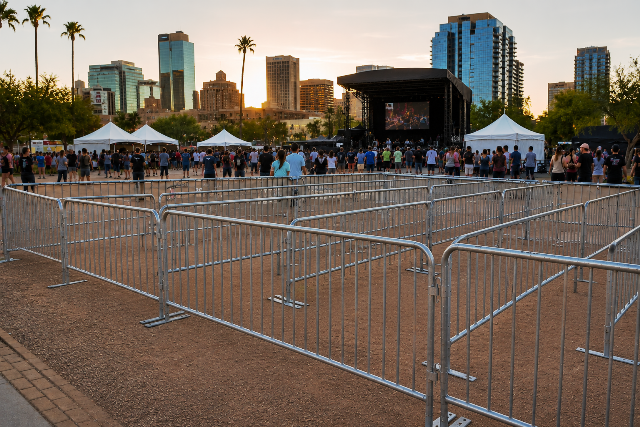
A festival layout is really a set of nested perimeters: the outer site boundary, the ticketed area, the vendor row, the stage front, and the backstage zone. Chain-link panels with windscreen handle the outer boundary and any areas you want screened. Bike rack barricades handle the front-of-stage rail and the entry queue. ZTERS describes temporary fencing as a way to direct event attendees or to create a perimeter around an area, which is exactly the kind of layering most festivals need. Walk the site before you order and mark every gate, because adding one after delivery usually means rearranging a whole run.
Races and Course Routes
Races ask the most of a fence line because the layout changes between the start corral, the course, and the finish chute. Corrals need controlled entry points. Course sections that cross public areas need a defined edge spectators can see. Finish areas need separation between runners, timing staff, and the crowd. Barricades that lock together and roll into position make the changeover between waves possible without a full teardown, and a fence plan that mirrors your course map saves volunteer guesswork on race morning.
Chain Link Panels or Bike Rack Barricades?
Both styles show up on Phoenix job sites, and the right answer depends on whether you need a boundary or a crowd line. Chain link panels are the heavier option and can carry windscreen. Bike rack barricades are lighter, faster to place, and better for guiding people. Many events use both at once.
|
Style |
Best for |
Notes |
|---|---|---|
|
Chain link fence panels |
Site perimeters, construction areas, back-of-house zones, long straight runs |
Accept windscreen and banner attachments; weighted bases hold the line |
|
Bike rack barricades |
Crowd control, entry queues, front-of-stage rails, field touchlines |
Quick to reposition and chain together into flexible lines |
|
Aluminum event fence |
Festivals and upscale events where appearance matters |
A cleaner look than standard chain link panels |
|
Portable fence with bases |
Turf, pavement, and dirt sites that cannot be dug into |
Held upright by weighted bases rather than posts set in the ground |
How Temporary Fence Rental in Phoenix Is Priced
Phoenix pricing is usually quoted in two ways: per linear foot or per section. A local event rental listing shows a portable fence in Phoenix, Scottsdale, Chandler, and Mesa at $2 per foot, with a base rental of $17.00 per 7-foot section. A separate Phoenix fencing rental profile lists a typical job cost range of $50 to $5,000, illustrating the difference between a small backyard run and a full commercial perimeter. Treat any published figure as a starting point and confirm it against your own layout, since delivery, installation, and accessories are often separate line items.
Two things move the number most. The first is length, because fence math is linear: doubling your perimeter roughly doubles your panel and base counts. The second is labor. If you want the provider to deliver and set the line, ask for that in the quote rather than assuming it is included. Base rental is often listed separately from the panel charge, which is why the per-foot rate can appear lower than the final invoice amount.
Sizing the Fence Line Before You Call
You do not need a CAD drawing to get an accurate quote, but you do need a few numbers. Measure the perimeter you want enclosed in linear feet, then add the interior lines you plan to run, such as a vendor row or a stage barrier. Count the gates and note the width each one needs. Finally, walk the site and confirm where a delivery truck can stage and where panels can be stacked before placement.
-
Sketch the site and mark the outer boundary, then mark every interior line.
-
Measure each run in linear feet and add them together.
-
Mark gate locations and note whether vehicles or only foot traffic will pass through each gate.
-
Note the surface under each run, since turf, dirt, and asphalt can change how bases are placed.
-
Identify a staging area for delivery and pickup that does not block your own setup.
Delivery, Setup, and Professional Installation
Professional installation is available for temporary fence panels, gates, bases, and accessories, and a single national provider handles this work. If your site has a tight delivery window, a load-in restriction, or a layout that has to be exact on the first try, installation is usually worth the line item. Providers who offer setup generally advertise fast delivery and expert setup, which removes the risk of a volunteer crew guessing at base placement in the dark. For events, the simplest path is often to order fencing from the same company that handles your tents, restrooms, and crowd control, so one crew handles the entire load-in.
Permits, Property Rules, and Site Coordination
Fencing rules depend on where you place it and who owns the ground. A city park, a private lot, a school field, and a closed public street can each have different requirements, so confirm the details with the city or the venue rather than relying solely on a rental contract. If your event requires a permit, the fence layout is often part of the site plan you submit, so finalize the positions before submitting the application. If you're using a leased space, check your lease and get written approval from the property owner first.
Pairing Fence with the Rest of the Event Order
Fence rarely travels alone. A festival perimeter usually comes with portable restrooms, generators, light towers, and staff. LP Rent-A-Fence and LP Solutions, for example, provide temporary fencing and portable sanitation for construction and event needs, which reflects how often the two are ordered together. Arizona Bounce Around covers a similar range of event needs, including inflatable fencing and crowd-control barricades to t, as well as tables, chairs, stages, generators, light towers, portable restrooms, event staff, and security. Ordering those items from one provider keeps delivery windows aligned and gives you a single point of contact when something shifts on site.
Pairing also solves small problems before they appear. Restrooms located inside a fence line need a nearby gate or a dedicated path. Light towers need a clear base area free of any panel runs. Staff and security need to move between zones without climbing anything. Map the fence first, then drop the rest of the equipment into the plan.
Booking Timeline and Practical Tips
Race weekends, holiday festivals, and spring tournament season fill up first, so reserve panels as soon as your date is locked. Confirm the delivery window in writing, including the pickup time, because a fence that sits on site an extra day can become an unplanned cost. Take photos of the finished setup, as they show exactly where the line started and help prevent disputes over base and panel counts at pickup.
Verify your linear footage twice. Decide gates before delivery, not after. Keep a small buffer of panels on hand for the inevitable adjustment. Label the runs if your site has multiple zones so volunteers know which panel goes where. None of that is complicated, and all of it saves time on the day the gates open.
Frequently Asked Questions
How much does temporary fence rental cost in Phoenix?
Pricing is usually quoted by the foot or by the section. A local Phoenix event rental listing shows a portable fence at $2 per foot, with a base rental of $17.00 per 7-foot section, and a separate Phoenix fencing rental profile lists a typical job cost range of $50 to $5,000. Delivery, installation, and accessories are often billed separately, so request an itemized quote for your exact layout.
Can I install temporary fence panels myself?
Yes, if you have the right bases and a reasonably level surface. Panels lock together and stand on weighted bases rather than posts set in the ground. That said, professional installation is available for panels, gates, bases, and accessories, and larger sites with tight delivery windows or exact layouts usually benefit from having a crew handle placement.
Do Phoenix rental companies deliver and set up fencing?
Many do. Some providers advertise fast delivery and expert setup, and general equipment branches let you reserve fencing online and pick it up in person. Local commercial fence companies in Phoenix also offer temporary fence rentals, as well as permanent installation and materials. Confirm delivery, setup, and pickup times in writing before your event date.
Can temporary fence be used for events instead of construction?
Absolutely. Temporary fencing is widely used to direct event attendees, form perimeters around festivals and fairs, and control crowd lines at races and concerts. Bike rack barricades and crowd control barricades are designed specifically for spectator areas, entry queues, and front-of-stage rails, while chain-link panels are used for outer boundaries and screened zones.
What should I have ready when I request a quote?
A sketch of the site, the total linear feet you need covered, a list of gate locations and widths, and the surface type under each run. If you are fencing a park, street, or leased property, note what approvals you already have. Those details let a provider price panels, bases, delivery, and installation in one pass.