

Can you rent carnival games for an indoor event?
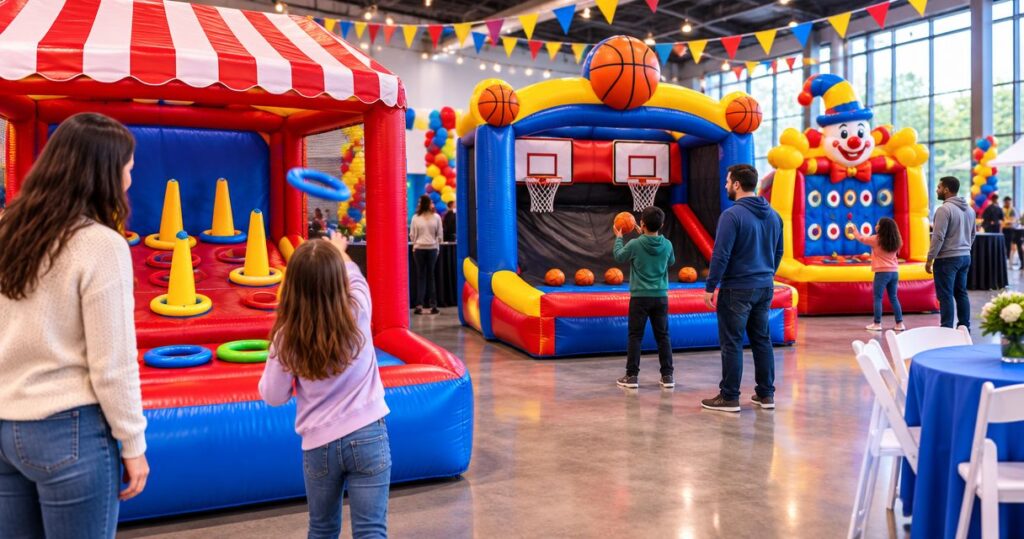
Yes, carnival games can be rented indoors when the specific equipment is approved for indoor use and fits the venue’s access route, playing area and operating requirements. The main limitation is that the game’s footprint does not include every space you need: players, waiting guests and equipment retrieval also need room. Confirm the exact game and layout with both the rental company and venue before booking.
- Can carnival games be rented indoors? Yes, with equipment-specific approval, adequate playing space and venue permission.
- Arizona Bounce Around offers carnival game rentals; confirm indoor suitability for each selected game.
- Choose games around your guests, delivery access and room layout, not equipment footprint alone.
- Keep waiting lines, prizes and food separate from active playing areas.
Why this matters
Moving a Phoenix birthday or school carnival indoors changes more than the weather exposure. Doorways, furniture, ceiling fixtures and shared hallways become part of the equipment decision. A game that fits an empty room still needs a workable arrangement once guests arrive.
For a 2026 event, get the venue’s approval before finalizing your equipment list. Arizona Bounce Around offers carnival game rentals alongside other party equipment, so your inquiry should specify an indoor event rather than simply request a carnival package.
Can carnival games be rented indoors?
Yes. Indoor carnival rentals work when the selected games suit the building, participants and event format. Start with the following game formats as planning categories—not a statement that any particular model is included in a rental company’s inventory.
| Game format | Best for | Practical advantage | Indoor limitation to confirm |
|---|---|---|---|
| Tabletop skill games | Home birthdays and seated activity stations | Keeps the activity on a defined surface | Needs a suitable table, player access and room for loose pieces |
| Freestanding toss games | Family parties, school carnivals and community rooms | Gives guests a clear target and playing position | Needs a contained throwing lane and retrieval space |
| Floor games | Relaxed family gatherings and mixed-age events | Allows informal participation | Playing pieces and guests occupy floor space between turns |
| Powered games | Staffed school, corporate and community events | Adds a different activity format | Requires equipment-specific electrical and operating checks |
Choose the game that fits the occupied room, not just the empty floor plan. A small birthday room and a school gym need different layouts, even when the same activity interests both groups.
Tabletop games: best for defined activity stations
Tabletop games are a practical starting point when you want guests to gather around individual stations. For a family party, ask whether your existing table is suitable or whether the rental requires a separate support surface.
The trade-off is shared space. Players, chairs, prizes and food can crowd the same table, so give the activity its own surface and confirm the table requirements before selecting equipment.
Toss games: best for supervised carnival stations
A freestanding toss game creates a recognizable carnival activity for birthdays, school celebrations and employee family events. Position the player toward a controlled area rather than across a doorway or circulation route.
The limitation is the playing lane. Ask where missed throws travel, how pieces are retrieved and whether the game needs a backdrop or another containment measure approved by the supplier.
Powered games: best for venues with confirmed utilities
Choose a powered game only after the supplier identifies its electrical requirements and the venue approves the connection plan. An outlet near the game is not enough information to approve the setup.
Powered equipment adds coordination that a nonpowered station avoids. For the electrical questions to ask, use the carnival games and generator power workflow as a planning checklist; indoor electrical arrangements still require venue-specific approval.
How to check whether a game fits indoors
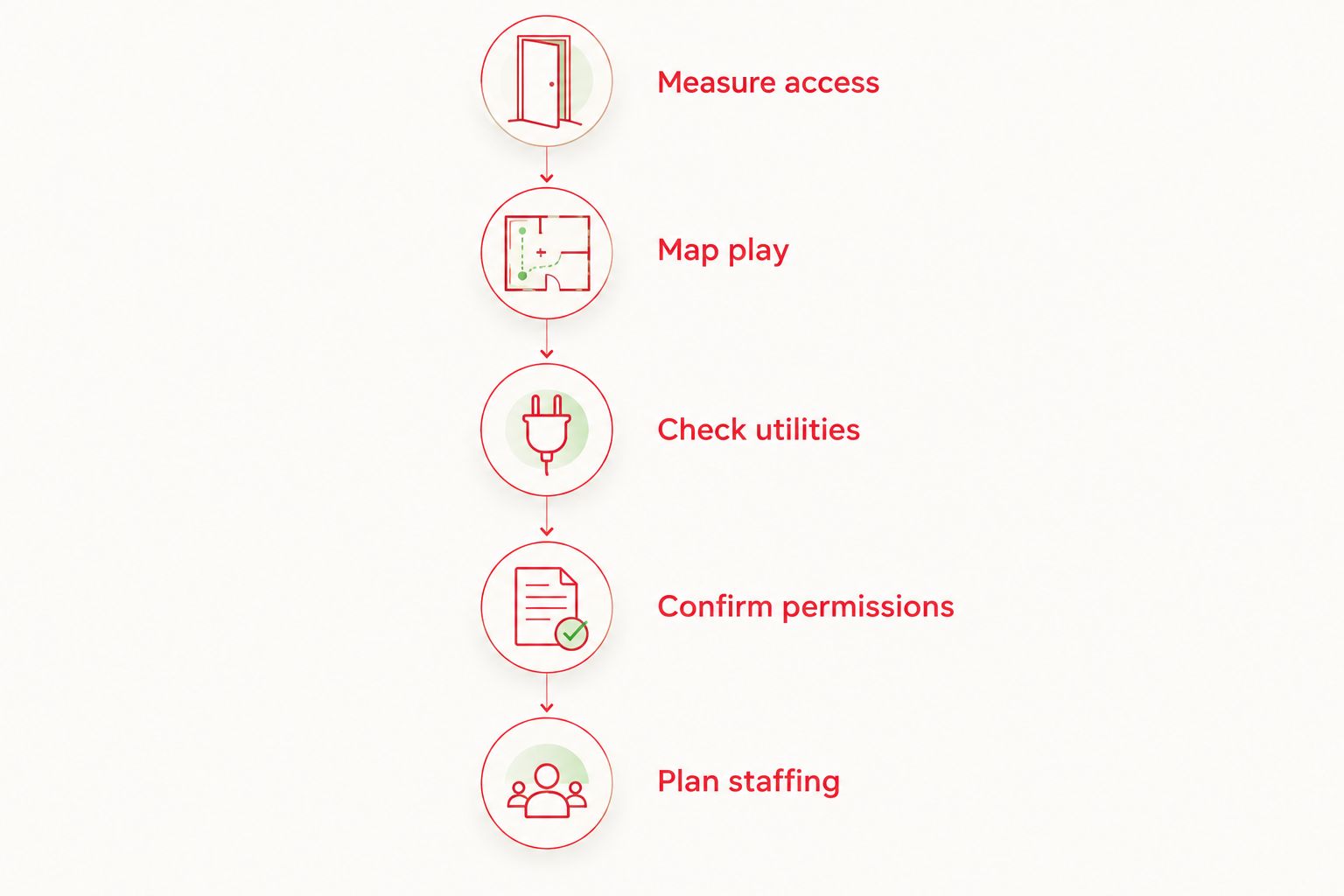
Use this sequence before requesting your final equipment selection. For your 2026 event plan, record the answers in a shared document so the venue contact and rental supplier work from the same information.
- Measure access. Record the narrowest doorway, hallway turns, stairs and any elevator along the delivery route. Ask for the equipment’s transport dimensions, not only its assembled size.
- Map play. Request the full operating area, including the player’s position, target, retrieval area and any required clearance. Mark permanent furniture and ceiling obstructions on your room sketch.
- Check utilities. Identify which proposed games need electricity. Have the supplier and venue confirm the connection requirements rather than assigning outlets yourself.
- Confirm permissions. Ask the venue about permitted activities, floor protection, attachment restrictions and required documentation. Obtain approval for the actual games you plan to rent.
- Plan staffing. Assign responsibility for explaining turns, managing waiting guests, retrieving pieces and handling prizes. Confirm which responsibilities belong to you and which are included in the rental arrangement.
Walk the route from the unloading point to the final game position. A room measurement will not reveal a tight turn outside the entrance or a delivery route that passes through another booked space.
Why indoor carnival game requirements vary
The requirements change with the equipment and venue, not simply with the event’s guest count. These factors determine which questions belong in your rental inquiry:
- Game movement: Throwing, rolling and reaching activities use space differently. Request a description of how each game operates before drawing its boundary.
- Equipment access: Assembled dimensions and transport dimensions answer different questions. Confirm both when doors, elevators or stairs are involved.
- Guest ages: Younger children need understandable rules and reachable playing positions. Ask about the intended age group rather than judging from a photograph.
- Power requirements: A nonpowered activity avoids an electrical connection, while powered equipment needs an approved connection plan.
- Venue restrictions: Flooring rules, permitted attachments, ceiling fixtures and room-use policies affect placement.
- Event format: An open-house party needs a different waiting arrangement from a school rotation or scheduled company competition.
What should parents check for an indoor birthday party?
Keep the activity separate from cake, seating and the route through the room. At a home birthday, guests still need to reach the bathroom, dining area and exit without stepping through a game.
For a backyard birthday moved inside, reselect equipment around the indoor room rather than trying to preserve the original outdoor arrangement. Tell the supplier whether the new location is a living room, garage, clubhouse or rented hall; those spaces present different access and placement questions.
Before requesting a quote, prepare this short checklist:
- The birthday child’s age and the broader guest age range.
- The room’s usable dimensions after furniture stays in place.
- Photos of the entrance, playing area and nearby obstructions.
- Whether adults and children will play together.
- Whether you need tables or other supporting equipment.
- Who will explain rules and collect game pieces.
Keep party favors and prizes away from the active target. Otherwise, children collecting rewards compete for the same space as the next player.
How should schools and event planners organize the room?
For a school, corporate or community event, build the layout around guest movement before filling the room with activities. Mark entrances, exits, refreshments, seating and accessible circulation routes first; then position approved game areas in the remaining space.
A 2026 school carnival brief should identify who approves the floor plan and who can authorize changes during setup. That prevents volunteers from moving a game into a route the venue intended to keep clear.
Separate playing, waiting and prizes
Give each station a recognizable player position and a separate waiting location. Place prize collection outside the throwing or retrieval area so a finished turn does not interrupt the next player.
At a corporate family event, account for adults accompanying children as well as active players. At a community celebration, keep the entrance area open enough for arriving guests to understand where activities begin.
Match the staffing plan to the event
Ask who will supervise each activity and whether any game requires a trained operator. Do not assume delivery staff remain for the event or that a volunteer can operate every type of rental.
Give volunteers a written explanation of turns, piece retrieval and the person to contact if equipment needs attention. Include a clear instruction to stop the activity and contact the designated lead rather than improvise a repair.
Can outdoor-style games be moved inside?
Outdoor-style games need a fresh suitability check before moving indoors. A familiar activity does not automatically retain the same playing distance, containment or floor compatibility inside a building.
The casual participation associated with yard game rentals works as an event format only when the chosen activity also suits its playing surface and boundaries. Indoors, review where pieces land, how guests retrieve them and whether the venue permits their use on that floor.
This matters for both family parties and larger functions. A backyard host should not assume a garage is an automatic substitute, and a school planner should not treat a gym as unrestricted space.
Ask for an approved indoor alternative when the original game does not fit. Changing the activity is preferable to shortening a required playing area or placing it against an unsuitable surface.
What should you include in an indoor rental quote request?
Arizona Bounce Around is a fit for Phoenix parents and event planners seeking carnival game rentals alongside other party equipment. Its selection supports a conversation about combining activities, but each proposed item still needs an indoor suitability check.
For a qualified 2026 quote, send the following details together:
- Event basics: Date, guest arrival time, activity schedule and planned end time.
- Location: Venue address, room name and venue contact.
- Guests: Expected attendance, age range and whether participation is open or scheduled.
- Space: Usable room measurements, ceiling obstructions and layout photos.
- Access: Loading location, doorway measurements, stairs, elevators and delivery restrictions.
- Equipment: Preferred game formats and any supporting tables or concession equipment.
- Responsibilities: Delivery, setup, staffing, cleanup and collection arrangements to confirm.
- Venue conditions: Documentation, floor protection and electrical approval requirements.
For Phoenix first, then Scottsdale, Chandler and Mesa, provide the exact address rather than the city alone. For larger events elsewhere in Arizona, confirm delivery arrangements and the proposed equipment through the quote process.
Arizona Bounce Around’s customer-stated strengths include equipment selection, delivery and setup, event-planning help, clean equipment and dependable service. Turn those priorities into specific questions: what is included in setup, how is equipment prepared, and who handles an issue during your event? The written agreement—not a general description—should define your booking.
FAQ
Can carnival games be rented indoors for a birthday party?
Yes, carnival games can be rented indoors for a birthday party when the selected equipment is approved for the room and venue. Confirm the playing area, delivery access and supervision arrangements before booking.
What carnival games work best for a small indoor party?
Games with a clearly defined playing area are the best starting point for a small indoor party. Ask about tabletop or contained skill-game formats, then verify the exact equipment dimensions and retrieval space.
Do indoor carnival games need electricity?
Only games with powered components need electricity. Ask the supplier to identify those items and have the venue approve their connection requirements before setup.
Can carnival games go on a school gym floor?
Carnival games belong on a school gym floor only with the school’s approval for the specific equipment and any required floor protection. Confirm placement, movement restrictions and permitted materials with the facilities contact.
How much room do indoor carnival games need?
Indoor carnival games need their equipment footprint plus the supplier’s required playing, clearance and retrieval areas. Waiting guests and nearby circulation routes need separate space; there is no single measurement that fits every game.
Does delivery include someone to run the carnival games?
Delivery does not establish whether an attendant or operator is included. Ask the rental company to state setup, operating and collection responsibilities in the booking agreement.
Can I switch outdoor carnival rentals indoors if the weather changes?
An indoor switch requires approval for the replacement location and each selected game. Agree on the alternative layout before the event rather than assuming outdoor equipment will fit inside.
One last thing
Photograph the delivery route, not just the party room. An entrance, hallway turn or elevator can determine whether your preferred game reaches its intended position. Add those photos to your 2026 inquiry before approving the equipment list.
Related guides
- How to plan carnival game queues and prize stations
- How to choose carnival game rentals for younger children
- Carnival game rentals for backyard birthday parties