

How many carnival games do you need for 100 guests?
For 100 guests, choose your carnival game count from the number of people playing at the busiest time and the confirmed capacity of each game—not the invitation total alone. There is no reliable fixed game count that fits every party of this size. Include time for instructions, collecting game pieces and awarding prizes when deciding whether your planned stations can serve the crowd.
- Decide how many carnival games for 100 guests using peak participation, not the invitation total alone.
- Confirm each carnival game’s player capacity, turn length and reset process before choosing quantities.
- Arizona Bounce Around offers carnival game rentals; request equipment recommendations against your guest mix and event layout.
- Count staffed, usable game stations—not simply the number of rental items on your list.
Why this matters
A backyard birthday with relatives eating and socializing puts different demands on carnival games than a school celebration where everyone arrives together. The guest total is the same; the demand for turns is not. Plan for the busiest period, rather than assuming every guest plays throughout the event.
For a Phoenix event in 2026, start your rental discussion with the guest mix, location and activity schedule. Arizona Bounce Around offers carnival games alongside other party equipment, so your request should explain whether games are the main attraction or part of a larger event.
How many carnival games do you need for 100 guests?
For 100 guests, the right quantity is the smallest workable set of game stations that can handle your expected peak participation with your chosen waiting time. Confirm that quantity against the actual equipment, staffing and site layout before booking.
Use this planning sequence rather than a generic guests-per-game rule:
- Count likely players. Separate participating children and adults from guests who primarily watch, eat or socialize. Do not automatically exclude adults; ask whether the event is designed for family participation.
- Identify peak participation. Decide whether guests arrive together, visit during an open-house period or rotate through scheduled activities. Focus on the busiest interval.
- Confirm game capacity. Ask how many people can play each selected game simultaneously and how a complete turn works.
- Include reset time. Account for explanations, retrieving pieces, scoring and handing over prizes. Playing time alone does not describe how quickly a station serves guests.
- Check the whole layout. Confirm that the proposed stations, waiting areas and attendants fit without blocking entrances, food service or other activities.
For a capacity calculation, use this relationship:
Station capacity = simultaneous players × completed turns during the planned activity period.
Then compare the combined station capacity with the turns your guests are expected to take during that same period. Use confirmed operating information—not an assumed turn length—and remember that total capacity does not guarantee equal demand at every game.
Choose the game format before choosing the quantity
Different game formats solve different planning problems. Your 2026 rental list should describe how guests will participate, not just how many pieces of equipment you want.
| Game format | Best for | Planning advantage | Limitation to check |
|---|---|---|---|
| Individual-turn games | Backyard birthdays and casual family parties | Guests can join without organizing a team | Instructions, retrieval and prizes all affect the queue |
| Simultaneous-player games | Shared activities and friendly competition | More than one guest participates during a round | Confirm actual player positions and how rounds start |
| Scheduled game rotations | School groups and organized youth events | Groups have a defined activity schedule | Transitions and staffing need advance coordination |
| Open-play game stations | Community gatherings and corporate family events | Guests choose activities around the rest of the event | Popular stations need separate queue planning |
These are planning formats, not confirmed rental packages. Ask which available equipment fits the format you want, and have the provider explain its operating requirements.
Individual-turn games: check the complete turn
An individual-turn game suits guests who want to join briefly and return to the party. Its usefulness depends on what happens between players, not just the action of playing.
Ask who explains the rules, collects pieces and determines the result. A station that depends on a busy host for every task needs a different staffing plan from one with a dedicated attendant.
Group games: check who actually participates
A shared activity does not automatically mean every waiting guest can participate at once. Confirm the player positions and whether the activity runs in rounds, teams or individual attempts.
For mixed-age family parties, also ask how the selected equipment accommodates different participants. Choose games for the people attending rather than assuming a large-looking attraction serves every age group equally well.
Why the carnival game count varies
These factors determine whether your proposed game lineup fits 100 guests:
- Guest mix: A children's birthday, extended-family gathering and employee event have different participation patterns. Describe who wants to play, not just who is invited.
- Arrival pattern: A shared start concentrates demand. A drop-in event spreads arrivals, but you still need to identify the likely peak.
- Other activities: Food, presentations and other entertainment change when guests approach the games. Put those activities on the same schedule.
- Game operation: Player positions, instructions, scoring and resets determine how each station works. Confirm these details for the selected equipment.
- Staffing: A game station needs the supervision or operation required for that equipment. Do not count a station as ready until those responsibilities are assigned.
- Site layout: Equipment footprints are only part of the space requirement. Include access, waiting areas and whatever clearance the provider specifies.
Do not solve a queue problem by adding equipment before checking its cause. A slow prize handoff or unclear instructions calls for an operating change; additional games do not fix that task.
Plan the site around play, waiting and prizes
Draw the event layout before approving your 2026 equipment list. Mark where guests arrive, where they play, where they wait and where they collect prizes. Keep the drawing simple enough to share with the venue and rental provider.
Use these areas as your checklist:
- Arrival: Show the entrance and the route guests use to reach activities.
- Game stations: Mark the proposed equipment locations and provider-specified operating areas.
- Waiting areas: Show where each line forms without taking over another activity.
- Prize collection: Identify whether prizes are handed out at games or at a separate station.
- Guest access: Preserve routes to seating, food, restrooms and exits.
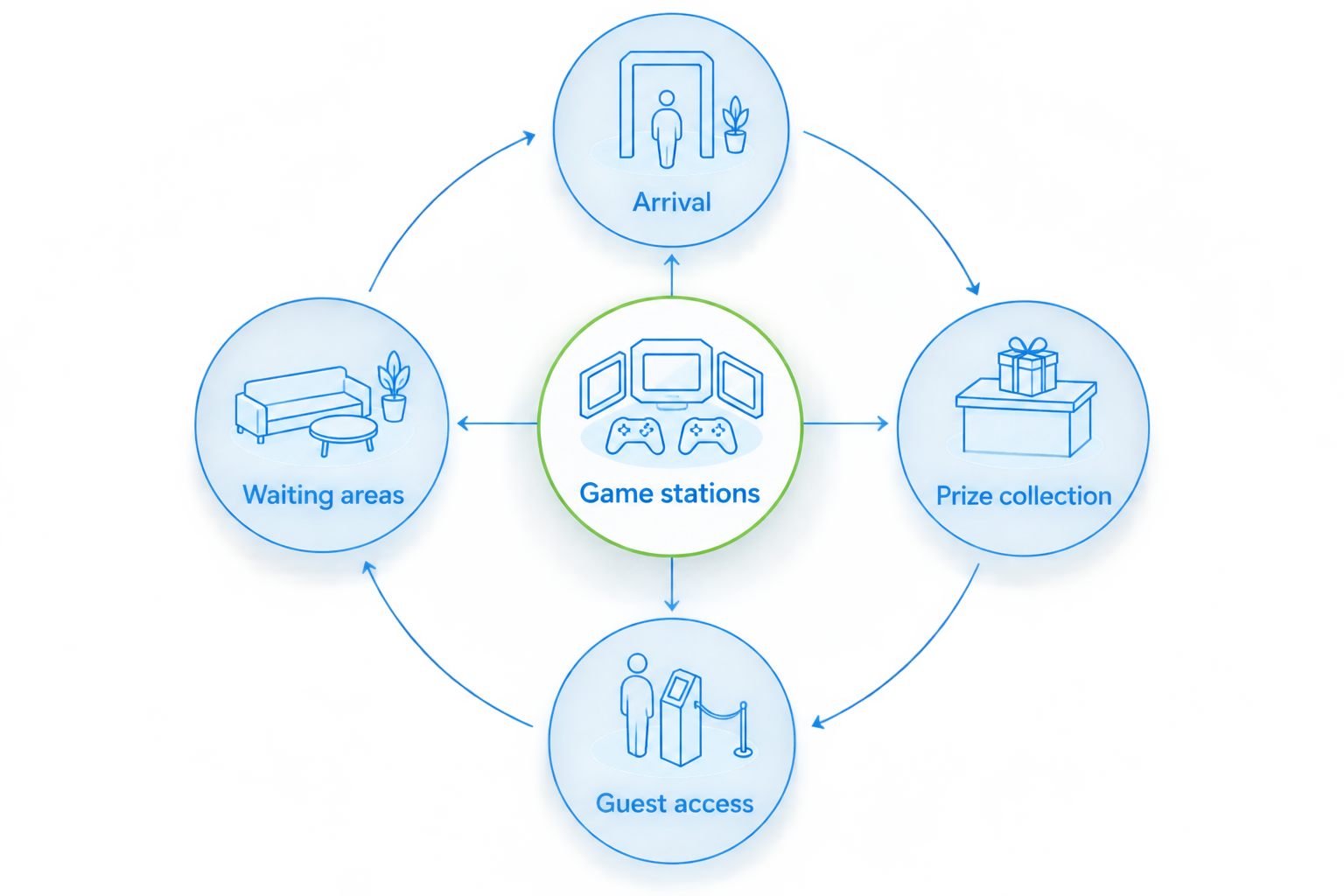
A separate prize station keeps prize selection away from the game itself, but it also creates another place to staff and manage. Handing out prizes at each game keeps that task local, but makes prize handling part of every turn. Choose the arrangement your helpers can operate consistently.
For a more detailed layout checklist, use the guide to planning carnival game queues and prize stations. Share the resulting sketch with everyone responsible for setup and guest flow.
What changes for a backyard birthday or family party?
For a 100-guest backyard party, count the intended players separately from the full family guest list. Ask whether adults will join the games, whether children will play repeatedly and whether games remain open during food or birthday activities.
Choose a lineup you can supervise without pulling every host away from the party. A wider selection gives guests more choices, but every added station brings equipment, operating and layout questions.
For Phoenix backyards, send photos of the proposed setup area and access route with your inquiry. Apply the same planning process in Scottsdale, Chandler and Mesa: identify the surface, gates, steps and other access details rather than assuming the guest count proves the equipment will fit.
Keep family logistics visible. Tell the provider where guests will sit, where food will be served and which areas must remain clear throughout the gathering.
What changes for a school, corporate or community event?
For a 100-guest organized event, match the game plan to the schedule and the people assigned to run it. A school rotation needs clear group transitions; a corporate family event needs equipment choices that reflect the attending age groups.
Community events also need a clear distinction between total attendance and participation during the game period. State whether the games are open throughout the gathering or only during a scheduled activity block.
Use a written responsibility list:
- Name the event contact and the person authorized to approve placement.
- Assign game operation and supervision according to the equipment requirements.
- Decide who explains rules and handles disputes or prize questions.
- Assign responsibility for replacing supplies and keeping waiting areas organized.
- Confirm who communicates schedule changes to attendants and the rental provider.
For larger Arizona events beyond the Phoenix area, request delivery and service confirmation for the actual location. Include the venue address and schedule; do not treat statewide service as confirmation of a particular delivery arrangement.
What to include in your rental quote request
Arizona Bounce Around is best suited to Phoenix planners seeking carnival game rentals alongside other party equipment. The company offers several equipment categories, but your quote still needs to identify the specific games and services appropriate for your event.
Send a short event brief for your 2026 booking:
- Event details: Date, venue address, guest arrival period and activity schedule.
- Guest profile: Total attendance, intended players and relevant age groups.
- Activity plan: Whether games are the main entertainment, an optional area or part of a rotation.
- Site information: Surface, access route, available setup area and venue restrictions.
- Operating plan: Your helpers, proposed game responsibilities and prize arrangement.
- Service questions: Delivery, setup, collection and any help needed to choose equipment.
Ask what cleaning preparation applies to the selected equipment, and confirm the agreed setup responsibilities in writing. These questions turn general expectations about clean equipment and dependable service into specific booking details without assuming a guarantee.
Request an itemized equipment list and an explanation of why the proposed stations suit your busiest period. A useful recommendation connects the game quantity to your event plan instead of repeating the attendance total.
Plan your carnival game rentals
Share your guest mix, event schedule and site details to request equipment recommendations.
FAQ
How many carnival games for 100 guests should I rent?
For 100 guests, choose the game count from expected peak participation and the confirmed operating capacity of the selected games. Include instructions, resets, staffing and prize handling before approving the quantity.
Does every guest need a carnival game spot at the same time?
Every guest needs a simultaneous game spot only if your activity plan requires everyone to play at once. Otherwise, plan around the busiest participation period and the waiting time you are willing to accept.
Should I count parents when planning carnival games?
Count parents who are expected to play, rather than automatically including or excluding every adult. Family participation changes the equipment mix and the demand for turns.
Do more carnival games always mean shorter lines?
More carnival games do not automatically shorten every line. Check whether the delay comes from a popular activity, slow resets, instructions or prize collection before adding equipment.
Can I use the same carnival game plan indoors?
An indoor game plan needs confirmation for the selected equipment and venue. Ask about operating space, access, power where applicable, and venue rules before transferring an outdoor layout inside.
What should I ask Arizona Bounce Around before booking?
Ask Arizona Bounce Around to recommend carnival games against your guest mix, peak activity period and site layout. Confirm the selected equipment, delivery and setup arrangements, operating responsibilities and any required supplies in your quote.
One last thing
Before approving your 2026 game list, walk through a complete turn on paper: a guest joins the line, hears the instructions, plays, receives the result and leaves. Assign every task in that sequence.
An unassigned reset or prize task is a planning gap, not a reason to guess at more games. Resolve that gap first, then confirm whether the proposed lineup serves your guests.
Related guides
- Carnival game rentals for backyard birthday parties
- Carnival game rentals for corporate family events
- Can carnival games be rented for an indoor event?