

What power supply does an LED dance floor rental need?
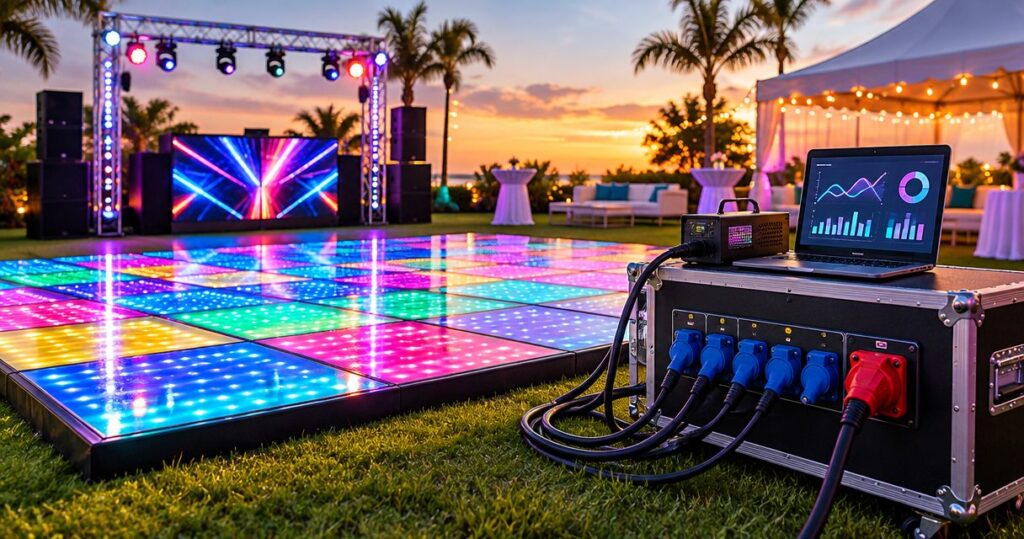
An LED dance floor rental needs a power source matched to the exact floor’s input voltage, maximum electrical load and connection instructions—not simply the nearest outlet. Confirm those requirements with the rental supplier, then have the venue verify the circuit and any equipment sharing it. Include controllers, power supplies and cable routing in your 2026 event plan before choosing building power or a generator.
- LED dance floor rental power requirements depend on the exact floor, power supplies and controller configuration.
- A nearby outlet does not prove that a circuit has enough unused capacity.
- Arizona Bounce Around suits planners seeking party equipment selection and help coordinating an event quote.
- Confirm the cable route and approved power source before finalizing the dance floor location.
What power supply does an LED dance floor rental need?
Use the floor supplier’s electrical specifications to choose the supply; do not choose the floor’s power arrangement by appearance. For a 2026 booking, request the input voltage, frequency, maximum input current or wattage, plug type and number of required supply connections.
For broader party equipment planning, Arizona Bounce Around offers rentals including tents, carnival games and concession equipment. List every powered item in the same event brief so the power discussion covers the whole setup.
Follow this sequence before approving a location:
- Identify the floor. Get the exact configuration and its electrical requirements from the supplier.
- Verify the circuit. Ask the venue which circuit supplies the proposed outlet and what else uses it.
- Plan the route. Share the distance and walking routes between the source and the floor.
- Confirm the setup. Have the supplier and venue agree on connections, cable protection and operating responsibilities.
An outlet photograph helps identify its location and visible connection type. It does not establish circuit capacity, grounding condition or suitability for the equipment.
Why this matters
Power planning determines where you can put the dance floor and what else can operate nearby. A floor beside a convenient wall outlet still needs a verified electrical arrangement.
For a backyard birthday, that means checking household loads before choosing a patio location. For a school dance or corporate celebration, it means coordinating with facilities staff before approving the room layout. Both events need the same basic answer: which approved source serves which equipment?
Settle the power plan before arranging tables, decorations and guest access around the floor. Moving the floor later also changes cable routes and usable event space.
What should you check on the equipment specifications?
Ask for the requirements of the complete rental configuration, not an individual lighting component. A panel label alone does not describe every power supply or controller used in the finished floor.
| Specification | What you need to confirm | Why it matters |
|---|---|---|
| Input voltage | Required supply voltage for the equipment | The source must match the rated input |
| Frequency | Required supply frequency | Equipment must suit the supply |
| Maximum input load | Rated current or power for the complete configuration | The venue needs it to assess circuit loading |
| Supply connections | Number and type of connections | The setup can require more than one connection point |
| Included equipment | Power supplies, controllers and related components | The power plan must cover the complete system |
| Connection instructions | Approved cables and distribution arrangement | Connector fit alone does not establish suitability |
Standard U.S. household power is nominally 120 volts at 60 hertz. Those figures describe the supply, not a universal specification for every LED dance floor.
Common household branch circuits are rated 15 amps or 20 amps. Neither rating tells you how much capacity remains after other connected loads, and neither confirms that a particular floor belongs on that circuit. Leave the loading assessment to the venue’s qualified electrical contact.
Building power or a generator: which fits your event?
Building power is the first option to assess when a suitable, verified source is within an approved cable route. A generator needs a separate suitability review; it is not a substitute for knowing the floor’s requirements.
| Power option | Best for | Practical advantage | Limitation to resolve |
|---|---|---|---|
| Building power | Indoor venues and backyards with a verified suitable circuit | Uses the venue’s existing electrical supply | Outlet location does not reveal shared loads or circuit condition |
| Generator power | Sites without a suitable accessible building supply | Provides a separate source for an approved event power plan | Requires equipment matching, placement, fuel planning and venue permission |
Building power: confirm the circuit, not just the socket
Ask the homeowner or venue contact to identify other equipment on the proposed circuit. Nearby sockets can share a circuit even when they sit on different walls.
For a family party, include nearby household appliances in that conversation. For a school or community venue, ask facilities staff about scheduled equipment use during the event—not just what is switched on during your site visit.
Generator power: confirm the complete arrangement
Give the generator provider the floor’s electrical specifications and the full connected-equipment list. Request confirmation of suitable output, connections, distribution and operating arrangements.
Fuel-powered generators must operate outdoors, away from doors, windows and vents because of carbon monoxide hazards. A generator’s location also needs to work with the approved cable route and guest layout; a convenient spot beside the dance floor is not automatically appropriate.
Why LED dance floor rental power requirements vary
These factors explain why a generic outlet count is not a reliable booking instruction:
- Floor configuration. The selected layout determines which panels and associated components are included. Request specifications for that arrangement.
- Power supply design. Different systems use different supply and distribution arrangements. Do not assume that one connection powers every floor.
- Controller requirements. Include the control equipment in the supplier’s electrical information rather than treating it as an unrelated accessory.
- Other connected equipment. A DJ system, decorative lighting or concession equipment changes the overall event power plan.
- Cable length and routing. The supplier needs the actual route to select suitable cabling and address voltage drop and cable protection.
- Site conditions. Indoor and outdoor locations require different checks for weather exposure, connections and access.
A larger-looking floor does not give you a usable electrical rating. Neither does the word “LED.” Use documented specifications rather than a visual estimate.
How do you plan the cable route?
Start with a simple site sketch showing the floor, proposed power source, entrances and guest walking paths. Mark the cable route as it will actually run, including any detour around seating or doorways.
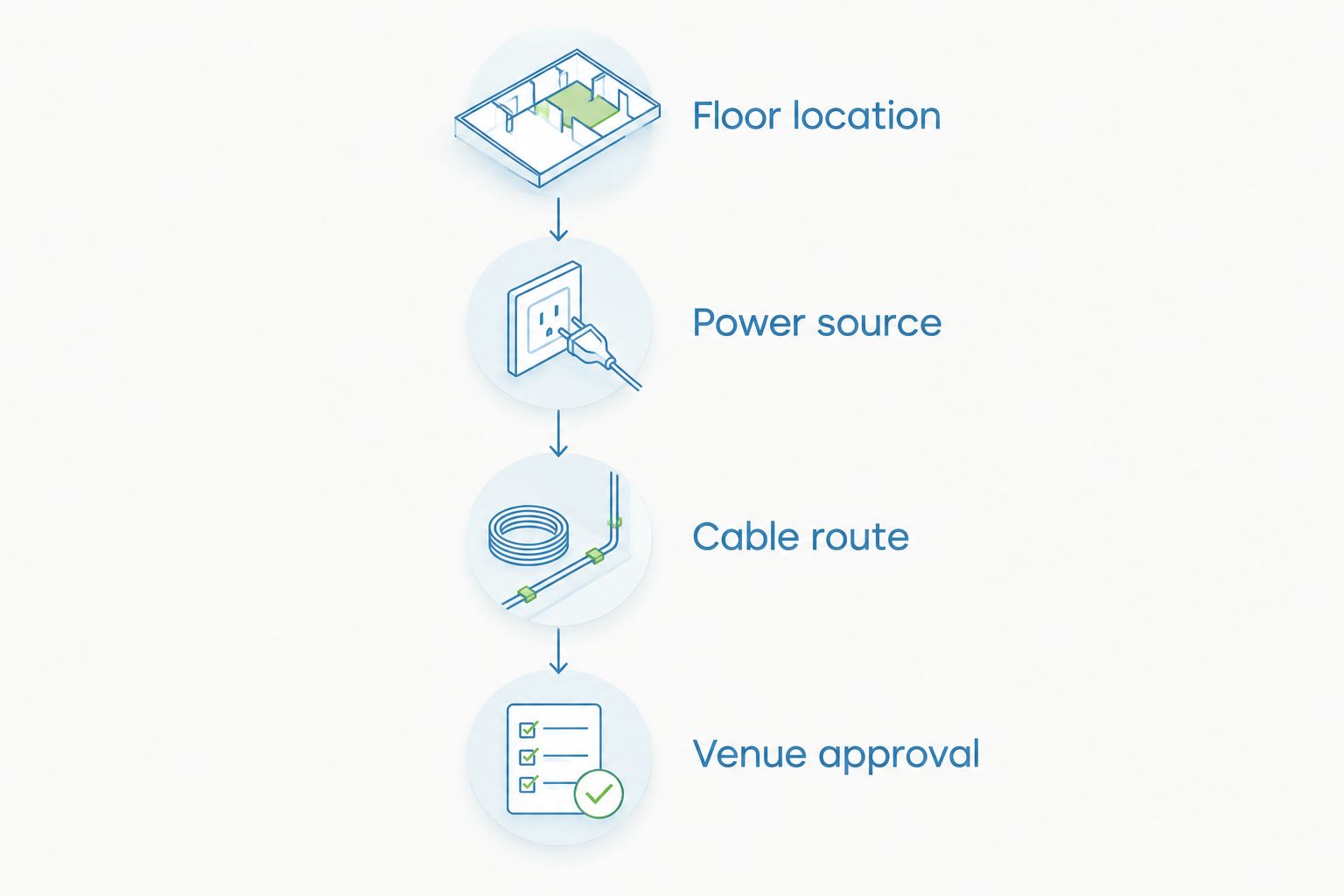
For your 2026 venue brief, use these four steps:
- Floor location: Mark the proposed floor position and nearby event activities.
- Power source: Identify the outlet or approved generator position for review.
- Cable route: Show the proposed path without drawing a straight line through guest areas.
- Venue approval: Have the venue and supplier resolve access, cable protection and connection details.
Measure the proposed route and send that measurement to the supplier. Do not select an extension cord from distance alone; cord suitability also depends on electrical load, conductor size, environment and the equipment instructions.
Keep exits and accessible routes part of the review. Ask the supplier and venue how they will protect any approved crossing rather than improvising with a loose cord across a walkway.
What should backyard party hosts check?
For a Phoenix backyard birthday or family celebration, begin with the proposed floor location and the nearest possible power source. Tell the supplier whether the route passes through a doorway, across a patio or near a pool or irrigation area.
Use this short homeowner checklist:
- Identify who can confirm the proposed circuit and access its breaker panel.
- List appliances and party equipment expected to operate at the same time.
- Send photographs of the outlet, floor area and proposed cable route.
- Disclose outdoor exposure and nearby water sources.
- Confirm who provides the approved cables and handles connections.
- Ask what action to take if power stops during the event.
The same checks apply to backyard events in Scottsdale, Chandler and Mesa. Do not run a cable through a closing door or add a household power strip as an improvised solution. Ask for a revised arrangement instead.
What should schools, companies and community venues check?
A school dance, corporate party or community celebration needs a named venue contact who can approve electrical use. Put that person in the planning conversation before the floor location becomes fixed.
For an HOA event, the LED dance floor clubhouse planning guide provides a related planning topic to review alongside your venue requirements.
Add these details to the professional event brief:
- Facilities contact: Identify who confirms circuits and authorizes connections.
- Equipment schedule: List the floor, sound, lighting and other powered rentals.
- Operating overlap: State which activities run simultaneously.
- Setup access: Confirm when staff can reach the room and electrical connections.
- Cable protection: Assign responsibility for approving and maintaining the route.
- Change control: Require approval before another vendor connects equipment to the assigned supply.
For larger events elsewhere in Arizona, request delivery, setup and service-area confirmation through the quote. Do not treat a statewide event plan as confirmation that particular equipment or delivery arrangements are secured.
What should you include in a qualified quote request?
For a 2026 quote, send the event city, venue, date, event hours, guest activities and proposed floor layout. Include photographs and the measured cable route, then ask for the exact electrical requirements in writing.
Arizona Bounce Around’s party rental selection includes tents, carnival games and concession equipment. Mention related rentals together so the planning discussion accounts for placement, delivery and setup questions across the event.
Request clear answers to these questions:
- What exact floor configuration does the quote cover?
- What input voltage, maximum load and connections does that configuration require?
- Must its supply circuit be dedicated?
- Which cables and distribution components are included?
- Who verifies venue power and who makes the equipment connections?
- What must change if the proposed source or route is unsuitable?
Ask about equipment preparation, cleaning and the event-day contact as separate service questions. Electrical specifications do not establish cleaning procedures or service commitments.
Can an LED dance floor share power with a DJ?
An LED dance floor should share a circuit with a DJ system only after the combined load and equipment instructions have been checked. A spare socket beside the DJ table is not confirmation.
Give the venue both suppliers’ requirements. Keep the approved arrangement unchanged when additional lighting or sound equipment arrives.
Does an outdoor LED dance floor always need a generator?
An outdoor LED dance floor does not automatically need a generator. Suitable building power can serve an outdoor arrangement when the equipment, connections, route and protection meet the supplier’s instructions and site requirements.
Confirm outdoor suitability separately. An acceptable power source does not make an indoor-only floor suitable for weather exposure.
What should you do if the power trips?
If the circuit trips, stop using the affected equipment and contact the designated venue or rental representative. Do not repeatedly reset the breaker or move the connection to an unidentified outlet.
Treat the interruption as a reason to check the approved arrangement. Keep guests away from affected cables or equipment while the responsible person assesses it.
FAQ
Can I plug an LED dance floor into a regular household outlet?
Use a household outlet only when its supply matches the floor’s specifications and the circuit has been verified for the connected load. A standard-looking socket alone does not establish suitability.
How many amps does an LED dance floor rental need?
The required amperage comes from the exact floor configuration and its power supplies. Ask the rental supplier for the maximum input current and required supply connections before assigning a circuit.
Does an LED dance floor need a dedicated circuit?
A dedicated circuit is required when the supplier’s instructions or approved electrical plan calls for one. Ask explicitly rather than assuming an otherwise unused outlet is dedicated.
Can I use my own extension cord for a rented LED dance floor?
Use your own extension cord only if the supplier approves it for the equipment, load, route and environment. Confirm who supplies cables before setup day.
What generator size should I book for an LED dance floor?
Choose a generator only after the floor supplier provides the complete electrical requirements. Have the generator provider account for every connected load and confirm suitable output and distribution.
Who should confirm power for a school or corporate dance?
The venue’s qualified electrical contact should confirm the building supply, while the rental supplier confirms the equipment requirements. Both need the same layout and connected-equipment list.
What should I confirm before a 2026 LED dance floor booking?
Confirm the floor configuration, electrical specifications, approved source, cable route and connection responsibilities before a 2026 booking. Include other powered equipment and request written answers with the quote.
One last thing
Two outlets do not necessarily mean two circuits. Put circuit identification—not socket counting—on your final venue checklist.
When requesting party equipment planning help from Arizona Bounce Around, send the layout and electrical questions with the event details. A specific brief makes it easier to resolve the setup before guests arrive.
Related guides
- Connecting concession equipment to generator power
- Connecting a mechanical bull to indoor venue power
- What to tell your Phoenix venue before booking tents