
How to plan generator power for concession machine rentals
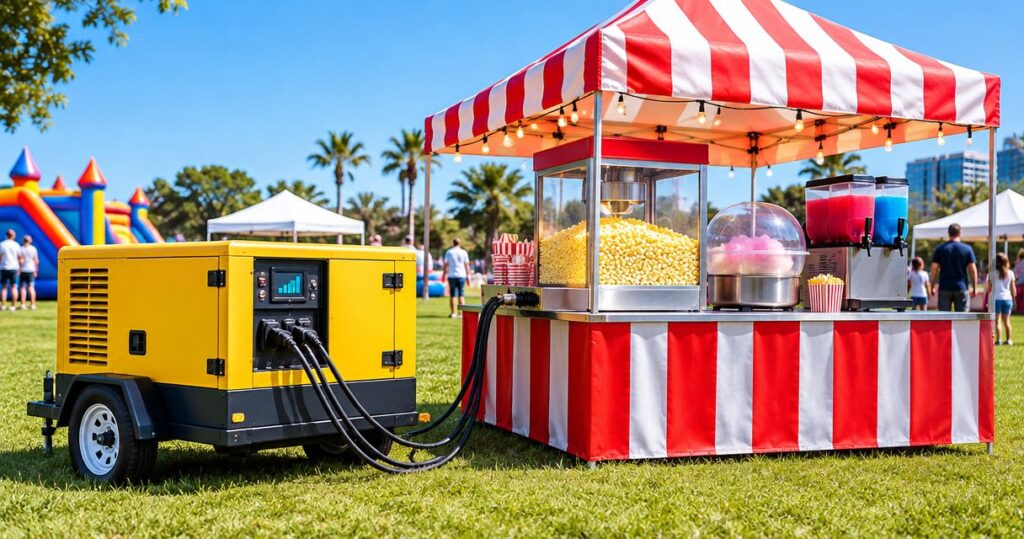
Instead of sorting out plugs and tripped breakers on party day, plan concession rental generator power from each machine’s electrical label, then have the rental provider approve the generator, connections and layout. This workflow takes you from equipment selection to a supervised operating check before guests arrive.
- Plan concession rental generator power from machine labels, not generator advertising or the number of outlets.
- Arizona Bounce Around concession rentals suit Phoenix event planners comparing food-service equipment alongside other party rentals.
- Confirm running demand, startup requirements, individual circuit limits and cord requirements before choosing a generator.
- Keep portable generators outdoors, at least 20 feet from buildings, with exhaust directed away from occupied areas.
Why this matters
A generator can have enough total output yet still trip a breaker when several machines share one circuit. Heating elements and motors also behave differently, so counting machines does not tell you how much power you need.
Arizona Bounce Around concession rentals are best for Phoenix parents and event planners choosing food-service equipment alongside other party rentals. Start with the equipment you want from Arizona Bounce Around, then request the electrical requirements for the actual machines being quoted.
For a 2026 backyard birthday, the plan might cover a serving table and nearby household power. A school carnival or corporate family event needs coordination across concessions, lighting and other powered attractions. Both need a named person responsible for the electrical setup.
Before you start
- Gather the equipment details. Get each machine’s model, electrical-label photo, operating instructions, voltage, frequency, running demand and any startup requirements. Include every other load sharing the proposed power source.
- Get site permission and support. Confirm generator rules, placement, operating hours, access and electrical responsibilities with the homeowner or venue. Have a qualified electrical professional resolve distribution, grounding, bonding or compatibility questions.
- Check the hidden limit: individual circuits. Separate generator receptacles can share a breaker. Obtain the generator manual and circuit information before assuming that different sockets provide independent capacity.
Do not select a generator from its advertised peak output alone. You need its continuous rating, receptacle limits and suitability for the actual loads and site conditions.
Equipment and load schedule
Record the machines before selecting the power source
- List every powered item. Include concession equipment, task lighting and any other equipment intended to share the source. Keep unrelated loads off the concession plan unless the provider approves them.
- Copy each electrical label exactly. Record volts, amperes or watts, frequency and plug configuration. A standard U.S. 120-volt, 60-hertz supply is not proof that every machine accepts that supply; the machine label controls.
- Ask about operating behavior. Identify machines with heating cycles or motor startup requirements. Ask the provider what demand must be allowed when equipment starts or reheats.
- Build a written circuit assignment. Have the provider or electrical professional assign each load to a suitable circuit and connection. Record which machines can operate together.
Expected result: Your equipment list identifies electrical requirements and approved circuit assignments, rather than just machine names.
For your 2026 event file, use a worksheet with these fields:
| Field | What to record | Why it matters |
|---|---|---|
| Equipment | Exact machine or model | Keeps requirements tied to the delivered unit |
| Electrical label | Voltage, frequency and input rating | Establishes the required supply |
| Operating demand | Running and applicable startup requirements | Supports generator selection |
| Connection | Plug, approved cord and circuit assignment | Prevents incompatible connections |
| Responsible person | Setup and operating contact | Makes questions and shutdown decisions clear |
If a label is missing or unreadable, request documentation before proceeding. Do not substitute the requirements of a similar-looking machine.
Choose between venue power and generator power
Use verified venue power when it meets the equipment requirements; use a generator when an approved site plan requires a separate source. Neither choice removes the need to check circuit capacity.
| Power option | Best for | Advantage | Limitation |
|---|---|---|---|
| Verified venue circuits | Backyard birthdays or indoor events with confirmed suitable circuits | Avoids generator exhaust and fueling arrangements | Convenient outlets can share circuits with other loads |
| Portable generator | Outdoor parties with an approved generator location | Provides a separate source where suitable venue power is absent | Requires exhaust separation, fueling controls and approved connections |
| Professionally planned generator distribution | School, corporate and community events with multiple powered areas | Coordinates loads and circuit assignments across the event | Requires more site information and electrical coordination |
For a Phoenix family party, check existing circuits before adding a generator. For a larger Arizona event, ask Arizona Bounce Around to coordinate equipment selection and delivery details through the quote, with electrical responsibilities stated separately.
Generator location and connection plan
Approve the location before measuring cords
- Mark the generator location. Keep portable generators outdoors, never inside a home, garage, tent or other enclosed or partially enclosed space. The CDC’s portable-generator carbon monoxide guidance calls for placement at least 20 feet from windows, doors and vents; choose a location at least that far from buildings and direct exhaust away from occupied areas.
- Check the entire surroundings. Account for neighboring buildings, open windows, air intakes, serving areas and queues. Carbon monoxide is odorless; smell is not a reliable warning.
- Measure the actual cable route. Follow the proposed protected route, not a straight line across a walkway. Give the distance to the provider so the cord type, conductor size and length can be approved.
- Resolve weather and public access. Keep equipment and connections dry according to their instructions. Ask the provider about a manufacturer-approved weather arrangement; do not improvise an enclosure that traps exhaust or heat.
Expected result: Your site drawing shows a suitable generator position and an approved cable route that does not create an unmanaged trip hazard.
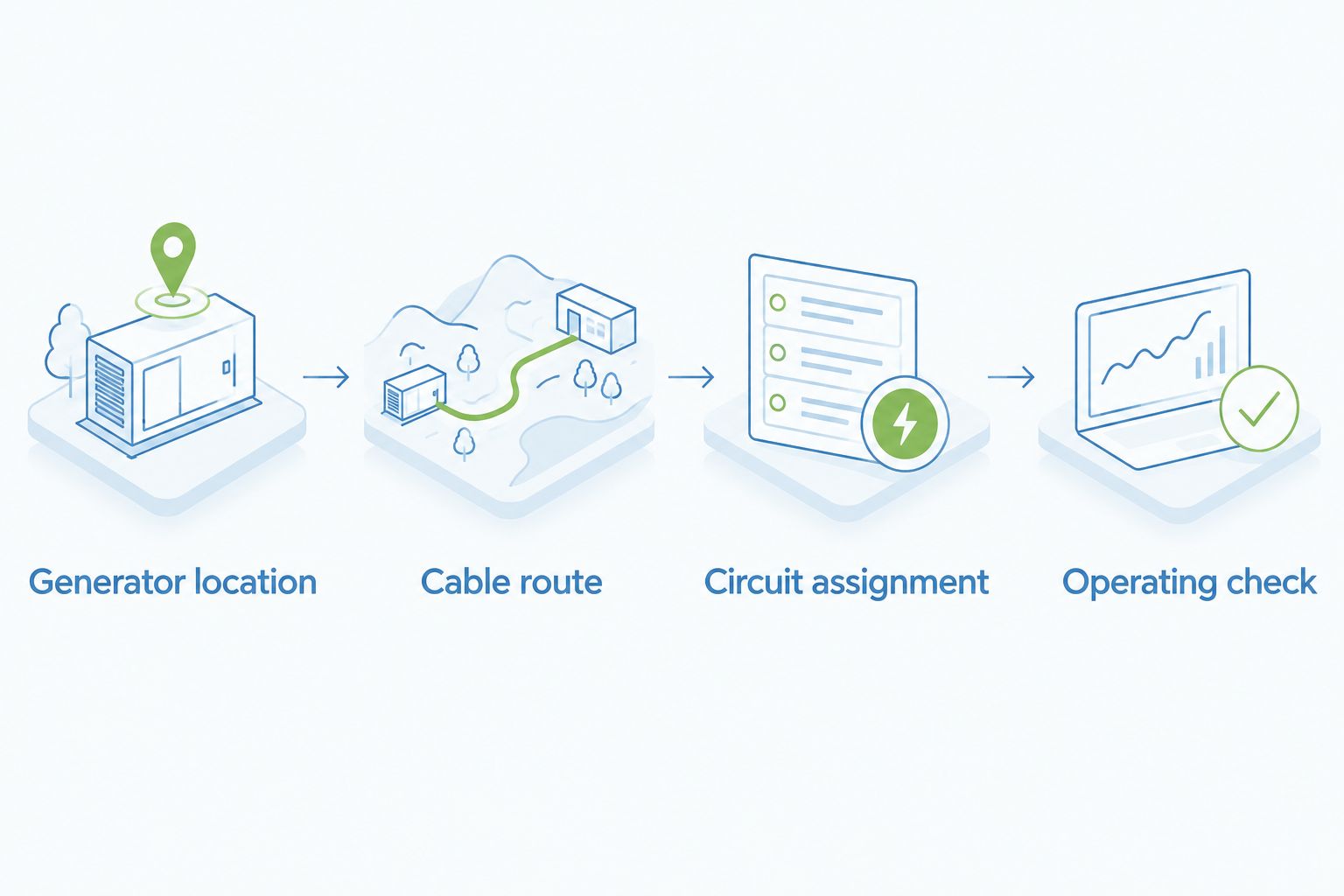
For your 2026 Phoenix site plan, do not move the generator closer to guests just to shorten a cord. Have the provider solve the connection requirements instead.
Confirm the electrical connections
- Match the supply to the machine. Have the responsible provider verify voltage, frequency, plug configuration and circuit capacity against the equipment documentation.
- Confirm approved cords and protection. Use only cords and distribution equipment suitable for the load, outdoor conditions and route. Have the responsible professional confirm ground-fault protection and grounding or bonding requirements for the specific arrangement.
- Inspect before connecting. Remove damaged cords, plugs or receptacles from use. Do not remove a grounding pin, force a plug or use an unapproved adapter to make a connection fit.
- Follow the equipment-specific sequence. Have the authorized person connect and start equipment according to both manuals. Switch names and startup procedures vary; do not substitute a generic sequence for the supplied instructions.
Expected result: Every machine has a documented, approved connection, with no improvised adapters or unresolved protection questions.
Never feed generator power into a household receptacle. Connecting a generator to building wiring requires proper transfer equipment and a qualified electrician.
Operating check and handoff
Test the planned combination before service
- Clear the operating area. Keep guests away from setup work, hot surfaces and electrical connections. Confirm that the generator position and cable protection match the approved plan.
- Start equipment as instructed. Let the responsible operator follow the manufacturer’s sequence. Do not start every load together unless the approved plan specifically allows it.
- Observe normal operation. Check the intended combination through its relevant operating cycles, including heating or motor operation. Stop if a breaker trips, equipment struggles, a connection becomes unusually hot or anything appears damaged.
- Hand over a written operating plan. Identify approved loads, prohibited additions, the shutdown procedure, the responsible operator and the contact for faults. Include fueling arrangements and weather-related stop conditions from the applicable instructions.
Expected result: The planned equipment combination operates without unresolved faults, and the event team knows who can change or shut down the setup.
A successful check does not authorize adding more equipment later. Keep the 2026 operating sheet beside the staff instructions, where volunteers and family helpers can find it.
For events sharing power with activity stations, the carnival games generator-power workflow provides another planning checklist. Keep all shared loads on the same event-wide schedule.
When the equipment list changes
A revised layout or extra machine requires another load review. An unused receptacle is not approval to connect another appliance.
For a backyard movie night, this matters when someone adds concession equipment to power already assigned to the projector and lighting. At a school carnival, the same problem appears when separate volunteers arrange different stations.
Use this change process:
- Add the proposed equipment and its electrical documentation to the load schedule.
- Ask the responsible provider to reassess continuous demand, startup requirements and circuit assignments.
- Recheck placement and cable routing if the serving station moves.
- Repeat the relevant operating check before serving guests.
Keep unapproved additions disconnected. Staggering startup does not solve excessive running demand once all the equipment is operating.
Troubleshooting
A breaker trips when another machine starts
Stop using the affected circuit and have the responsible operator investigate the load assignment and startup requirements. Do not repeatedly reset the breaker, bypass protection or move plugs randomly between outlets.
A machine heats poorly or its motor struggles
Stop the machine and ask the provider to check the supply, cord suitability and equipment condition. Low voltage, an unsuitable connection or a machine fault needs diagnosis, not a larger breaker.
Ground-fault protection trips
Disconnect the affected setup through the authorized operator and have it inspected for moisture, damaged equipment or other faults. Do not bypass ground-fault protection to keep service running.
Connections become wet or unusually hot
Keep people clear and have the responsible person shut down the affected setup safely. Do not handle wet electrical connections or continue operating with damaged plugs, softened insulation or signs of overheating.
The generator stops during service
Follow the generator’s shutdown and restart instructions and investigate the cause before reconnecting loads. For refueling, OSHA portable-generator guidance calls for shutting the generator down and letting it cool; never refuel a running generator.
Customize your workflow
For a Phoenix backyard birthday, send Arizona Bounce Around the address, date, chosen concession equipment, serving hours, yard layout and proposed power source. Ask what equipment-selection help, delivery, setup and operating instructions the quote includes; confirm cleaning expectations and your own responsibilities as well.
For family parties in Scottsdale, Chandler and Mesa, add gate access, patio or yard surfaces, nearby buildings and the route from unloading to the serving area. A short route for people does not necessarily make a suitable route for electrical cords.
For school, corporate and community events, submit a detailed 2026 site brief:
- Event address, site contact and venue permissions.
- Equipment list and expected simultaneous operation.
- Serving schedule, setup window and collection arrangements.
- Proposed generator position and measured cable routes.
- Other powered attractions and the person coordinating distribution.
- Operator assignments, shutdown responsibilities and weather arrangements.
For larger events elsewhere in Arizona, confirm delivery arrangements and site requirements through the quote. The company’s equipment selection helps you plan multiple event areas, but each powered item still needs its own electrical review.
FAQ
What size generator do I need for concession rentals?
Choose a generator only after confirming each machine’s running demand, applicable startup requirements and circuit assignment. Have the rental provider or a qualified electrical professional approve the continuous output, receptacles and distribution arrangement.
Can I plug several concession machines into one generator?
Several machines can share a generator only when the approved load and circuit plan allows it. Separate sockets can share a breaker, so outlet count does not establish usable capacity.
Can I use a household outlet instead of a generator?
Use household power only when the circuit and connection meet the machine’s requirements. Have the homeowner and responsible provider identify other loads sharing that circuit before approving it.
How far should the generator be from the concession table?
There is no single table-distance rule that replaces a site assessment. Keep the generator outdoors, follow CDC guidance for separation from windows, doors and vents, and direct exhaust away from guests, workers and occupied areas.
What extension cord should I use for concession equipment?
Use the cord type, conductor size and length approved for the equipment, load and installation conditions. Give the provider the measured route and never choose a cord solely because its plug fits.
Can a generator run under a party tent?
Do not operate a portable generator inside a party tent or another enclosed or partially enclosed space. Arrange an outdoor location and manufacturer-approved weather protection without trapping heat or exhaust.
What should I send Arizona Bounce Around for a power-planning quote?
Send Arizona Bounce Around your equipment choices, event address, serving schedule, site layout and proposed power source. Request the actual machines’ electrical requirements and written confirmation of delivery, setup and electrical responsibilities.
One last thing
Photograph the electrical labels on arrival and compare them with your approved schedule before connection. If the delivered machine differs from the planned model, ask the provider to confirm the power requirements again. A matching equipment category is not a matching electrical specification.
Related guides
- Concession rentals for backyard movie nights
- School-event concession volunteer checklist
- Connecting a mechanical bull rental to indoor venue power