

How many guests can use a dunk tank during an event?
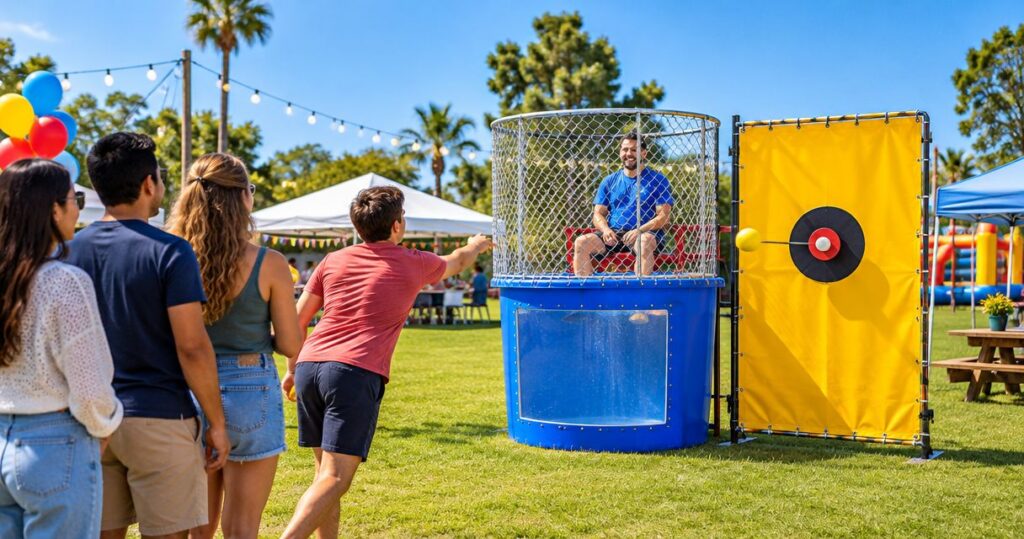
A dunk tank rental has no universal guest limit for an entire event: attendance capacity depends on how long throwing turns take, how long the tank operates, and how often guests repeat. Plan capacity around completed throwing turns, not total event attendance, and confirm the seated participant’s restrictions separately from the number of people waiting to throw.
- How many people can use a dunk tank rental depends on operating time, complete throwing turns, and repeat participation.
- Separate throwing guests, seated volunteers, and spectators when planning dunk tank capacity.
- For Phoenix events, confirm setup, water access, operating rules, and volunteer responsibilities before setting a participation target.
- Arizona Bounce Around offers party equipment planning for backyard celebrations and larger Arizona events.
Why this matters
A guest list does not tell you how many people will finish a turn. Some guests watch, some throw repeatedly, and others arrive together during a short break in the event schedule.
For your 2026 event, decide whether the dunk tank is a casual side activity or something every interested guest should have time to try. That choice determines whether you need an informal line, scheduled groups, or another activity beside it.
Arizona Bounce Around is best for parents and event planners seeking party equipment selection and planning help in Phoenix. Start with Arizona Bounce Around when preparing an equipment inquiry, then describe your participation goal rather than sending only an attendance figure.
How many guests can use a dunk tank during an event?
Estimate event capacity by dividing the time available for throwing by the length of a complete throwing turn. This estimates turns, not unique guests: repeat players use part of the same operating window.
Use this process before promising that everyone can participate:
- Set operating time. Identify when the attraction actually opens and closes. Keep delivery, filling, instructions, breaks, and closing tasks outside the throwing window.
- Define each turn. Agree on the permitted throws and when a guest must leave the throwing position. Follow the supplied operating instructions.
- Include the reset. Account for collecting balls, checking that the attraction is ready, and moving the next guest into position.
- Allow for interruptions. Leave room for seated volunteer changes, questions, and any required operating pauses.
- Separate repeat participation. Decide whether returning guests can immediately rejoin or should wait until newcomers have participated.
The planning formula is straightforward:
Estimated throwing turns = usable operating time ÷ complete turn time.
Use the same time unit on both sides of the calculation. Do not treat the result as a guaranteed capacity; an estimate is only useful when its assumptions match the actual operating plan.
Count the right kind of participant
A dunk tank attracts different kinds of participation. Keep them separate in your 2026 event plan so a large audience does not become an unrealistic throwing target.
| Participation type | Best for | What to count | Benefit | Limitation |
|---|---|---|---|---|
| Throwing guests | Planning the queue | Completed throwing turns and repeat visits | Connects participation to operating time | Turns do not equal unique guests |
| Seated volunteers | Planning the dunking schedule | Approved volunteers and their changeovers | Makes volunteer coverage explicit | Eligibility depends on the actual equipment rules |
| Spectators | Planning the surrounding area | People watching rather than throwing | Recognizes the attraction’s audience | Watching does not measure throwing capacity |
Ask a separate question about the person being dunked: who is eligible to use the seat? Confirm the actual unit’s age, size, swimming, and other participation requirements with the provider. Never infer seat eligibility from someone’s ability to throw a ball.
Choose an operating format that matches your guest list
There is no single event format that makes a dunk tank suitable for every guest count. Choose the format around your schedule and the participation experience you want, then check it against the equipment instructions.
| Operating format | Best for | Main advantage | Main drawback |
|---|---|---|---|
| Open queue | Backyard birthdays and informal family parties | Guests join when interested | Repeat players can fill the line |
| Scheduled groups | School celebrations and organized youth events | Spreads participation across the schedule | Requires coordination with group leaders |
| Featured volunteer sessions | Company picnics and fundraisers | Gives guests a clear reason to gather | Interest can concentrate into a short window |
Open queue: keep backyard participation simple
For a Phoenix backyard birthday, establish a visible waiting position and explain what ends each turn before play begins. Decide how repeat turns work so an enthusiastic guest does not unintentionally dominate the activity.
An open queue suits a family party where the dunk tank is optional. Its weakness is predictability: a quiet period does not mean the line will stay short when relatives arrive or another activity finishes.
Give nonparticipants somewhere else to spend time. Parents planning a mixed-age celebration should choose additional equipment according to the guests’ interests and the separate requirements for each attraction.
Scheduled groups: protect school and community schedules
For a school or community event, assign groups an opportunity to visit rather than promising that every attendee will finish a turn. A scheduled visit still needs enough operating time for the group’s actual participation.
Tell group leaders how the queue works, where students wait, and who handles questions. Do not assume a teacher or volunteer is qualified to operate the equipment simply because that person is supervising a group.
Featured sessions: plan for concentrated interest
A teacher, manager, or community volunteer in the dunk seat gives people a particular session to attend. Treat that session as its own capacity problem rather than averaging interest across the whole event.
For a 2026 fundraiser or company picnic, agree on the session schedule before promoting it. Confirm volunteer eligibility and replacement arrangements before naming participants in event materials.
Why dunk tank capacity varies
The useful capacity question is not just how many guests attend. It is how much operating time each completed turn consumes under your event’s rules.
- Turn format. The permitted throws and end-of-turn rule determine how long guests occupy the throwing position.
- Reset process. Ball collection and readiness checks belong inside the turn estimate, not outside it.
- Volunteer changes. Switching seated participants interrupts throwing and needs a planned procedure.
- Arrival pattern. A crowd arriving after lunch creates a different queue from guests visiting throughout the event.
- Repeat participation. Returning players increase completed turns without increasing the number of unique guests served.
- Operating pauses. Required breaks and interruptions reduce the time available for participation.
Do not shorten an equipment-required procedure to meet a participation target. Change the event plan when the capacity estimate does not fit; do not change the operating rules.
Prepare the site before estimating the final schedule
A capacity plan assumes the attraction is ready when guests arrive. Confirm delivery access, the proposed placement, water arrangements, and the closing procedure before treating an opening time as settled.
For practical questions to include in that discussion, use the guide to connecting a dunk tank rental to a water source. Ask the provider to confirm requirements for the actual equipment rather than borrowing specifications from another rental.
Backyard and family-party checklist
For a Phoenix home event, share more than a photograph of the lawn. Explain how the equipment reaches the proposed setup area and where guests will gather.
- Identify the delivery entrance and any gates or access restrictions.
- Describe the proposed surface and nearby obstacles.
- Identify the water source for the provider to assess.
- Ask how filling and draining fit the property and rental schedule.
- Keep the throwing queue separate from household access and other activities.
- Confirm who supplies supervision and who operates the equipment.
For Scottsdale, Chandler, and Mesa parties, include the actual address in your inquiry. Do not assume a nearby city means identical delivery arrangements or venue requirements.
School, corporate, and community-event checklist
Professional planners should include the venue contact and event schedule with the equipment inquiry. A quote is more useful when the provider can assess the site and the intended operating plan together.
- Identify the person authorized to approve equipment placement.
- Share the expected attendance and the desired throwing participation separately.
- Mark group arrival periods, meal breaks, and featured sessions.
- Explain whether the public, invited guests, or registered groups will participate.
- Confirm operator responsibilities and volunteer handoffs.
- Ask about site access, water, drainage, and venue documentation.
- Establish who makes operating decisions if conditions change.
For larger events elsewhere in Arizona, request confirmation of delivery arrangements and equipment availability through the quote. Statewide event planning should start with the location and logistics, not an assumed service window.
What should you send with a dunk tank quote request?
Send the event date, address, venue type, attendance, desired operating window, and intended participation format. Add your proposed setup location and the questions that need venue approval.
Arizona Bounce Around offers party equipment including carnival games, tents, and concession equipment. For dunk tank rental planning, ask Arizona Bounce Around to confirm the equipment, delivery and setup scope, operating responsibilities, and any additional activities appropriate to your event.
Use this short brief for a 2026 inquiry:
- Event purpose: Backyard birthday, family reunion, school fundraiser, company picnic, or community celebration.
- Participation goal: Casual drop-in play or an opportunity for each interested guest.
- Schedule: Guest arrival, desired opening, featured sessions, breaks, and closing.
- Site details: Address, access route, surface, water location, and venue contact.
- Responsibilities: Equipment operation, queue management, seated volunteers, and cleanup arrangements.
Ask how equipment cleaning is handled and what setup support is included. Get those details confirmed instead of treating clean equipment, staffing, or setup assistance as an unstated guarantee.
Plan your event equipment
Share your location, guest list, operating window, and site details for a qualified equipment inquiry.
Does every guest need a turn at the dunk tank?
Not every guest needs a throwing turn unless that is an explicit goal of your event. For a family party, optional participation lets guests choose between watching, throwing, and other activities.
For a school rotation, define the goal more carefully: visiting the station and completing a throwing turn are different outcomes. Communicate which experience the schedule is designed to provide.
Will more seated volunteers increase guest capacity?
More seated volunteers do not automatically increase throwing capacity. Volunteer changes consume operating time, so arrange them around the event schedule rather than assuming that more names mean more completed turns.
A replacement volunteer helps with continuity only when that person meets the equipment requirements and understands the procedure. Confirm the handoff process before guests begin lining up.
Should you add another activity instead of extending the line?
Another activity gives guests an alternative, but it does not increase the dunk tank’s own throughput. Choose it when your goal is a broader party experience rather than a dunk tank turn for everyone.
For a backyard celebration, consider guests who do not want to throw or watch. For a large event, consider whether the alternative creates another queue that also needs space and supervision.
FAQ
How many people can use a dunk tank rental at an event?
The event total depends on usable operating time divided by the time needed for each complete throwing turn. Subtract interruptions and account for repeat players before estimating unique guests.
How many people can sit in a dunk tank at once?
Follow the supplied instructions for the actual dunk tank’s seat occupancy and participant restrictions. Do not treat the event’s throwing capacity as permission for additional people to use the seat.
Can children be dunk tank volunteers?
Children should use the dunk seat only when the actual equipment instructions and provider’s requirements permit it. Confirm eligibility before offering a child a seated volunteer role.
Can a dunk tank handle a whole school fundraiser?
A dunk tank can be part of a school fundraiser, but school attendance alone does not establish throwing capacity. Match the participation goal to operating time, turn format, and volunteer changes.
Does adding more throws change how many guests can participate?
More throws per turn use more of the operating window when other conditions remain the same. Agree on the turn format before estimating how many guests will finish.
What should I ask Arizona Bounce Around before booking?
Ask Arizona Bounce Around to confirm equipment options, site requirements, delivery and setup scope, and operating responsibilities. Include your event address, schedule, guest count, and participation goal.
Should a backyard party use the same queue plan as a company picnic?
A backyard party and a company picnic need queue plans suited to their schedules and guest behavior. Informal parties can use an open line, while featured company sessions need a plan for concentrated interest.
One last thing
The longest line can appear during the shortest part of the event. A featured volunteer session or a school group’s release time deserves its own participation estimate, even when the overall schedule looks generous.
Before finalizing your 2026 plan, review the busiest expected arrival period. If the queue does not fit the available space or time, adjust the session format, repeat-turn policy, or surrounding activities before publishing the schedule.
Related guides
- Dunk tank rentals for Phoenix school fundraisers
- How to plan carnival game queues and prize stations
- Party rentals for Phoenix backyard birthdays