
How to plan power for an inflatable obstacle course rental
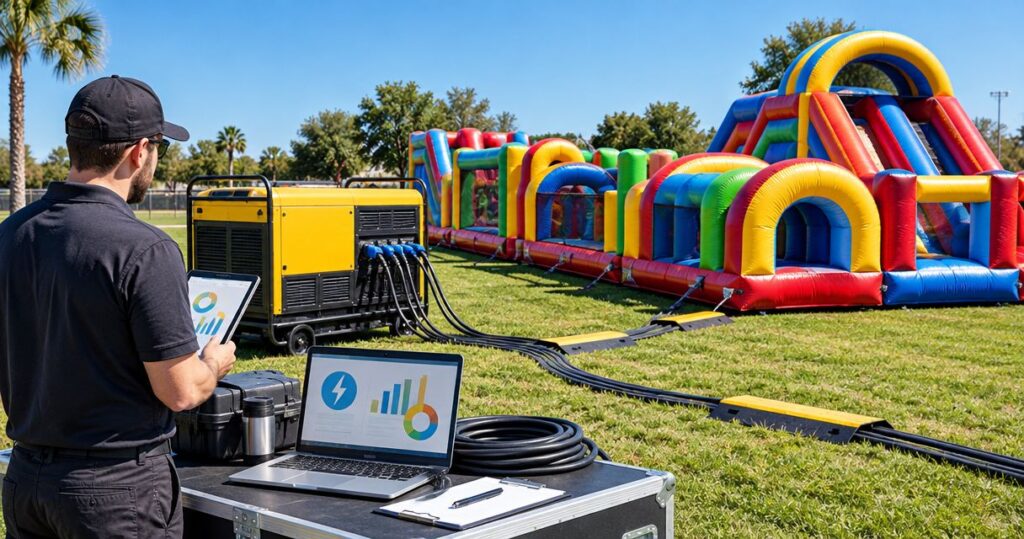
Instead of guessing which outlet will run an inflatable obstacle course, confirm the blower specifications and map the power supply before booking. This workflow turns obstacle course rental power requirements into a written plan for venue circuits, generator selection and setup-day checks.
- Confirm obstacle course rental power requirements from the exact blower specifications, not the inflatable’s size.
- Arizona Bounce Around suits Phoenix families and event planners comparing inflatable rentals and broader party equipment.
- Separate outlets do not necessarily mean separate circuits; have the venue confirm the circuit assignments.
- Choose generator capacity only after confirming running loads, motor-starting needs and other connected equipment.
Why this matters
An obstacle course needs more than an outlet within reach. Its blowers need a suitable electrical supply throughout operation, and an interruption can cause the inflatable to lose pressure. Confirm power before you finalize the equipment layout.
Arizona Bounce Around offers inflatable and carnival party equipment for backyard birthdays, school events, corporate gatherings and community celebrations. The right rental choice starts with matching the equipment to your guests, site and power supply—not choosing equipment first and solving electricity on arrival.
For a 2026 Phoenix birthday, that means checking the backyard circuit as carefully as the gate opening. For a school field day in Chandler or a community event in Mesa, it means getting the venue’s facilities contact involved before assigning activity locations.
Before you start
- Gather the exact equipment information. Ask for the obstacle course configuration, blower count, electrical ratings and manufacturer’s power instructions. Include every other powered rental in the same request.
- Get access to the site and the right contact. Bring a layout, outlet photographs and measured cable routes. Ask the property owner or facilities manager to identify circuits; leave electrical testing and panel work to qualified personnel.
- Resolve the hidden gotcha: shared circuits. Outlets on different walls can share a breaker. A nearby refrigerator, concession machine or other load can be on the same circuit even when it sits outside the event area.
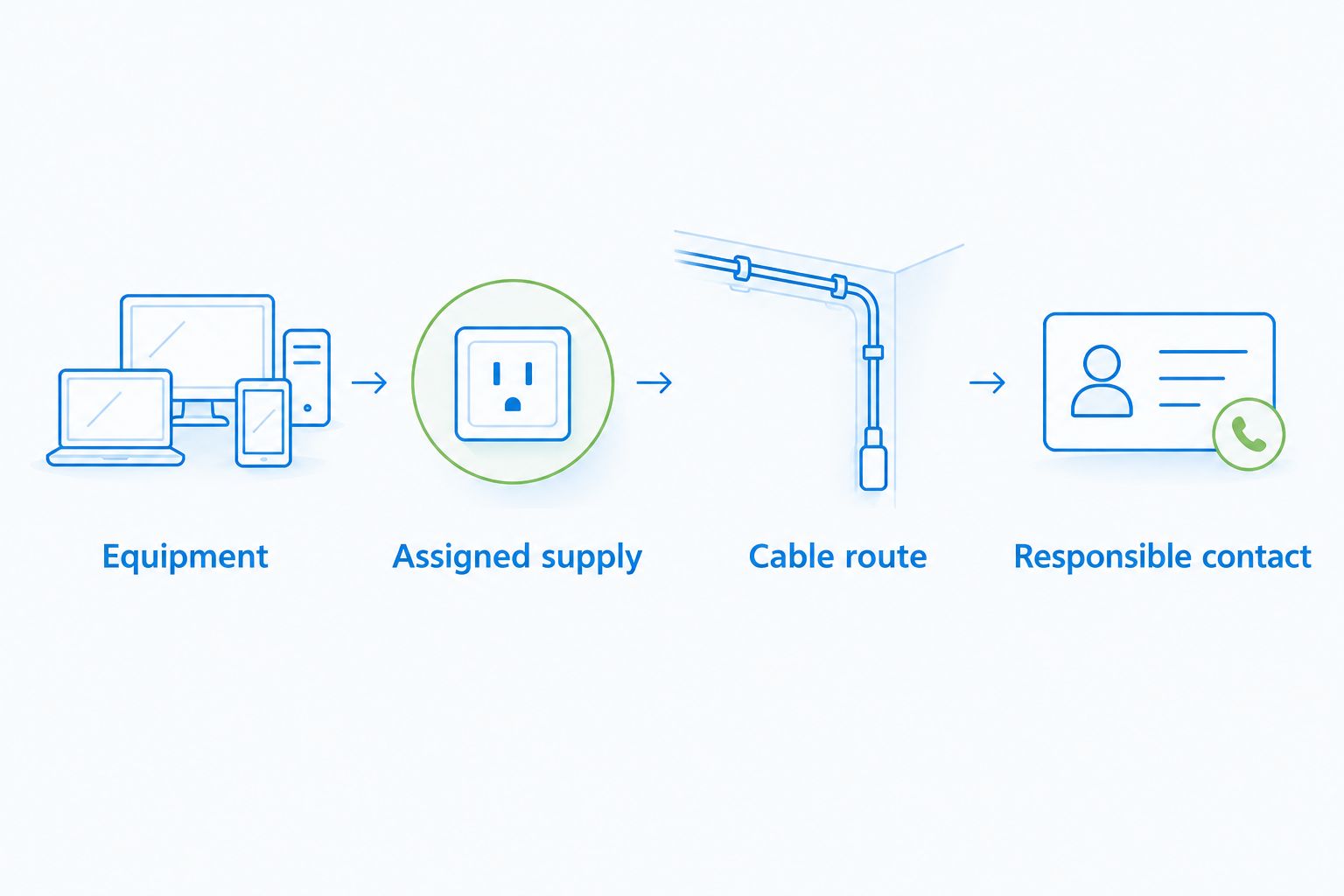
Use a written planning sheet with these fields: Equipment, Blower count, Electrical rating, Assigned supply, Cable route and Responsible contact. These are planning labels, not settings on a rental system.
Equipment load schedule
Confirm what the obstacle course actually needs
- Identify the exact obstacle course and every section included in the proposed layout. Do not substitute specifications from a similar-looking inflatable.
- Ask the rental provider to identify each required blower and its nameplate information. Record voltage, current and any stated running or starting requirements.
- Request the manufacturer’s instructions for supply connections, extension cords and operation. Ask the provider to explain anything the instructions leave unclear.
- List other equipment that needs electricity, including concessions, lighting, sound and any additional inflatables. Mark which items the venue expects to share a supply.
Expected result: You have an equipment-specific load schedule that the rental provider and venue can review together.
In the United States, ordinary receptacle circuits commonly supply 120 volts and have 15-ampere or 20-ampere circuit ratings. Those figures describe common building circuits; they do not establish what your obstacle course needs or how much capacity remains available.
Do not choose a generator from blower horsepower alone. Motor-starting demand, output connections and the generator manufacturer’s instructions also matter. Have the equipment provider confirm the proposed match rather than treating a simple conversion as approval.
For your 2026 event file, save the approved specifications beside the rental description. If the equipment changes, treat the original power plan as needing review.
Venue circuit map
Match the supply to the physical layout
- Mark the inflatable footprint, blower positions, guest entrance and exit on the site plan. Keep the power route separate from the activity route wherever the approved layout allows.
- Ask the venue contact to identify the circuit serving each proposed outlet. Record existing loads and any restrictions on using those outlets.
- Measure the actual cable route around fences, landscaping and pedestrian areas—not a straight line across the site.
- Send the circuit information and route measurements to the rental provider. Have the provider confirm suitable cords, connections and protection for the installation.
Expected result: Each blower has an identified supply and an approved cable route, with no unresolved assumption about shared circuits.
For a Phoenix backyard party, include the patio, side gate and any indoor appliances connected to the proposed circuit. For a Scottsdale family gathering, check whether the shortest cable route crosses the route guests use between the house and yard.
Schools and corporate venues need the same checks at a larger scale. Ask facilities staff which outlets remain accessible during the event and who can respond if power fails.
The event-site measuring guide for obstacle course rentals helps you coordinate the footprint with access and activity space. Measure before approving the power route; moving the inflatable can change the entire connection plan.
Power-source selection
Choose venue power or generator power
Neither source wins automatically. Use venue power only when its suitability is confirmed; use generator power only when the equipment match and placement are approved.
| Power source | Best for | Main advantage | Main limitation | Approval needed |
|---|---|---|---|---|
| Venue power | Backyards and venues with confirmed suitable circuits | Avoids placing and managing a portable generator | Outlet location and shared loads can restrict the layout | Circuit suitability, existing loads and cable route |
| Generator power | Sites without a suitable venue supply | Allows a power plan independent of building outlets | Adds exhaust, fuel, placement and operating responsibilities | Capacity, starting demand, connections and operating plan |
- Compare the confirmed venue supply against the equipment instructions. Do not count an unverified outlet as usable capacity.
- If generator power is needed, give the generator supplier the complete load schedule. Include starting requirements and all proposed connected equipment.
- Confirm the generator’s rated operating output, receptacles and distribution arrangement. A headline output rating alone does not confirm compatibility.
- Assign responsibility for delivery, placement, operation, fuel management and shutdown. Record who has authority to stop the activity if the supply becomes unsuitable.
Expected result: The selected power source has written confirmation tied to the actual equipment—not a generic generator recommendation.
Portable generators produce carbon monoxide. Operate them outdoors, never inside a garage, tent or enclosed structure, and follow manufacturer instructions for placement, exhaust direction and refueling. Keep guests away from the generator and its connections.
For a 2026 Arizona community event outside the Phoenix area, include generator logistics and site access in the quote request. Confirm delivery arrangements and equipment availability directly rather than assuming a larger site has a workable power supply.
Setup and handover
Verify the complete installation before guests enter
- Have the rental crew check that the delivered obstacle course and blowers match the approved plan. Stop and resolve any substitution before connecting equipment.
- Have the responsible personnel inspect the supply, cords and connections. Keep damaged equipment out of service; do not improvise adapters or defeat protective devices.
- Have the provider start and check the equipment according to its instructions. Test the intended operating arrangement, including other approved loads, rather than checking each item separately and assuming the combination works.
- Walk through the shutdown and response procedure with the designated event contact. Confirm how attendants will stop entry and direct participants out if inflation or power is lost.
Expected result: The responsible people have checked the installation, understand the operating instructions and know how to respond to an interruption.
A running blower is not the whole handover. The course also needs the provider’s separate setup, anchoring, weather and supervision checks. Electrical approval does not replace those requirements.
Second workflow: adding equipment after the first plan
A birthday can grow from one activity into a larger family party. A school carnival can add concessions after its original site plan is approved. Any powered addition needs a power-plan review before it gets connected.
- Add the new equipment and its electrical specifications to the load schedule.
- Have the venue or power supplier check the affected circuit or generator arrangement again.
- Update the cable routes, operating responsibilities and setup checks.
- Share the revised plan with everyone responsible for delivery and operation.
When comparing inflatable obstacle course options, treat each proposed configuration as a separate power-planning question: a different arrangement requires confirmation of its actual blowers and connections, not reuse of the first option’s assumptions.
This distinction matters for mixed equipment packages, too. Carnival games do not all have the same electrical needs; identify which proposed items actually require power. The carnival games and generator power workflow covers that related planning task without treating every attraction as an identical load.
For a 2026 school or corporate event, keep one current schedule rather than separate equipment lists held by different volunteers. Mark revisions clearly so an earlier layout does not guide setup.
Troubleshooting
The breaker trips when equipment starts
Stop use and have the responsible personnel investigate the circuit, connected loads and equipment. Do not repeatedly reset the breaker, replace it with a larger rating or move plugs between unidentified outlets. Resume only after the cause is resolved and the supply is approved.
Separate outlets still interfere with each other
Have the venue confirm their circuit assignments. Different receptacles can share a circuit, so moving a plug across the patio does not prove electrical separation. Update the circuit map instead of guessing from outlet location.
The generator runs, but a blower struggles to start
Keep the inflatable out of use while the provider and generator supplier check starting demand, connections, output suitability and other loads. Do not bypass protection or assume that a running engine means the electrical supply is correct.
The cable route is longer than planned
Remeasure the actual route and ask the provider to approve the revised arrangement. Cord length and conductor size affect electrical performance. Do not solve the problem by chaining together whatever extension cords are nearby.
The inflatable begins losing pressure
Stop entry and follow the provider’s procedure for getting participants out. Keep the activity closed while qualified personnel identify the cause. Restoring electricity alone is not permission to reopen; the provider must confirm the equipment is ready for use.
Customize your workflow
Make the quote request specific enough to resolve decisions, not just collect an equipment name. For Arizona Bounce Around inflatable rentals, include your preferred obstacle course arrangement and ask for help matching equipment to the site and guest group.
For backyard birthdays and family parties:
- Give the Phoenix, Scottsdale, Chandler or Mesa event address and the usable yard area.
- Include gate access, ground surface, outlet photographs and measured cable routes.
- Identify nearby powered party equipment and household loads for the circuit review.
- Ask who supplies approved cords and who handles delivery and setup.
For schools, corporate events and community gatherings:
- Provide a site plan, facilities contact and complete powered-equipment list.
- Identify opening hours, setup access and the person responsible for the power supply.
- Ask how equipment selection, delivery, setup and cleaning preparation are addressed in the rental arrangement.
- For larger statewide Arizona events, request confirmation of delivery logistics and availability by quote.
Arizona Bounce Around’s broad party-equipment selection helps you discuss inflatables, carnival games, tents and concessions together. The limitation is practical: a combined equipment list still needs individual power checks. Do not treat a package discussion as electrical approval.
FAQ
What are obstacle course rental power requirements?
Obstacle course rental power requirements depend on the exact blowers, their electrical ratings and the manufacturer’s instructions. Ask the rental provider to confirm the required supply, connections and cord arrangement for your chosen configuration.
Can I plug an inflatable obstacle course into a backyard outlet?
Use a backyard outlet only after the provider and responsible venue contact confirm it is suitable. Check the circuit assignment, existing loads, outdoor electrical protection and cable route before setup.
What size generator do I need for an obstacle course rental?
Choose generator capacity from the confirmed running loads, motor-starting requirements and other connected equipment. Have the rental provider and generator supplier approve the match; inflatable size alone does not establish generator capacity.
Do separate outlets mean I have separate circuits?
No, separate outlets can share the same circuit. Have the property owner or facilities manager confirm circuit assignments rather than relying on outlet location.
Can concessions share power with the obstacle course?
Connect concessions to the same supply only when the complete arrangement has been approved. Add each concession machine’s electrical requirements to the load schedule before deciding where it connects.
What should I do if the obstacle course loses power?
Stop entry and follow the rental provider’s procedure for directing participants out. Keep the equipment closed until responsible personnel resolve the fault and the provider confirms it is ready to reopen.
What should I send Arizona Bounce Around before requesting a quote?
Send the event address, date, guest group, preferred equipment, site measurements and available power information. Include access details and a venue contact so equipment selection and setup requirements can be discussed together.
One last thing
Label the approved power connections before guests arrive. A clear equipment assignment helps prevent someone from borrowing an outlet for a last-minute speaker or concession machine. For your 2026 event, put the current power plan beside the site layout and give the event lead both documents.
Related guides
- Bounce house rental and generator power planning
- Water slide rentals in Phoenix: water and power access